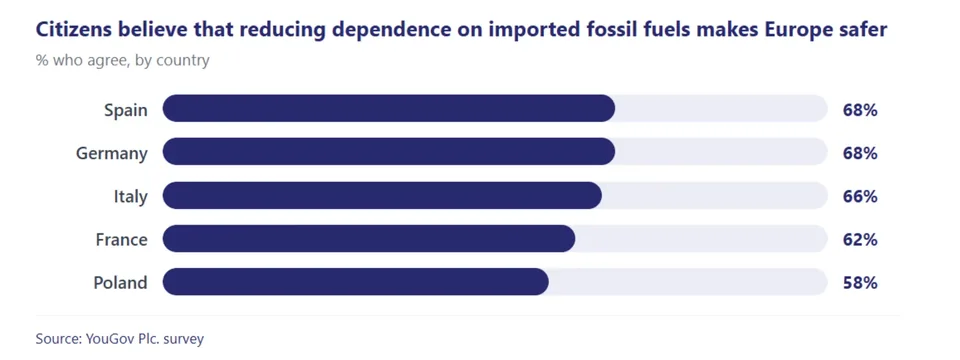
New polling data across five major European countries shows strong support for electrification and clean energy investment, cutting across traditional left-right political divides. Over 6 in 10 Europeans surveyed believe that reducing dependence on imported fossil fuels makes Europe safer. This view is reflected in the results of a recent poll conducted across five major European countries.
The crisis in the Strait of Hormuz has continued for over 100 days at the time of publication, highlighting the need for a secure energy supply. The EU's efforts to reduce dependence on imported fossil fuels are gaining traction, with over two-thirds of respondents backing this approach. This shift in public opinion presents an opportunity for policymakers to accelerate electrification and reduce fossil fuel dependence.
In four out of six countries surveyed, EU EV funding commands majority support, with Spain, Germany, Italy, and France all backing the initiative. Direct government support for household EV purchasing is also gaining popularity, particularly in these same countries. This level of public support underscores the need for policymakers to prioritize electrification and reduce fossil fuel dependence.
European cooperation is seen as more important during the current energy crisis, with 68% of respondents in Spain agreeing that this is the case. Similar sentiments are expressed in Germany, France, and Italy, highlighting the need for EU countries to work together to address energy security concerns. Poland's response is less enthusiastic, but still shows a growing recognition of the importance of cooperation.
Centre-right voters are among the most supportive groups for clean electrification measures, including in Germany, Italy, and France. This finding suggests that the debate around electrification is becoming increasingly non-partisan, presenting an opportunity for policymakers to drive this agenda forward.
The findings create a political opportunity for Europe to rebuild a shared narrative around independence, protection, and prosperity. By prioritizing clean energy transition, policymakers can position themselves as champions of European safety and security, rather than defenders of volatility and external vulnerability.
At a time when citizens are demanding greater stability and security, continued defence of fossil fuel dependence means defending these very same vulnerabilities. This is an increasingly untenable position, highlighting the need for policymakers to take bold action to reduce dependence on imported fossil fuels.
The EU's Electrification Action Plan should accelerate heat pumps, EVs, and charging infrastructure as the backbone of energy security. By doing so, policymakers can deliver on the mandate for electrification and create a more resilient and affordable clean energy transition for all Member States.
Reducing fossil fuel dependence is a goal in its own right, pursued with the same zeal as the electrification rollout. Policymakers must treat this objective with equal urgency, working to reduce reliance on imported fuels and promote energy security across Europe.
Increasing energy cooperation is essential to overcome Europe's vulnerabilities and build energy independence. This means cooperating on grids, infrastructure, and joint procurement to ensure a resilient and affordable clean energy transition for all Member States.
The findings highlight the need for a unified European approach to address energy security and reduce dependence on imported fossil fuels.