
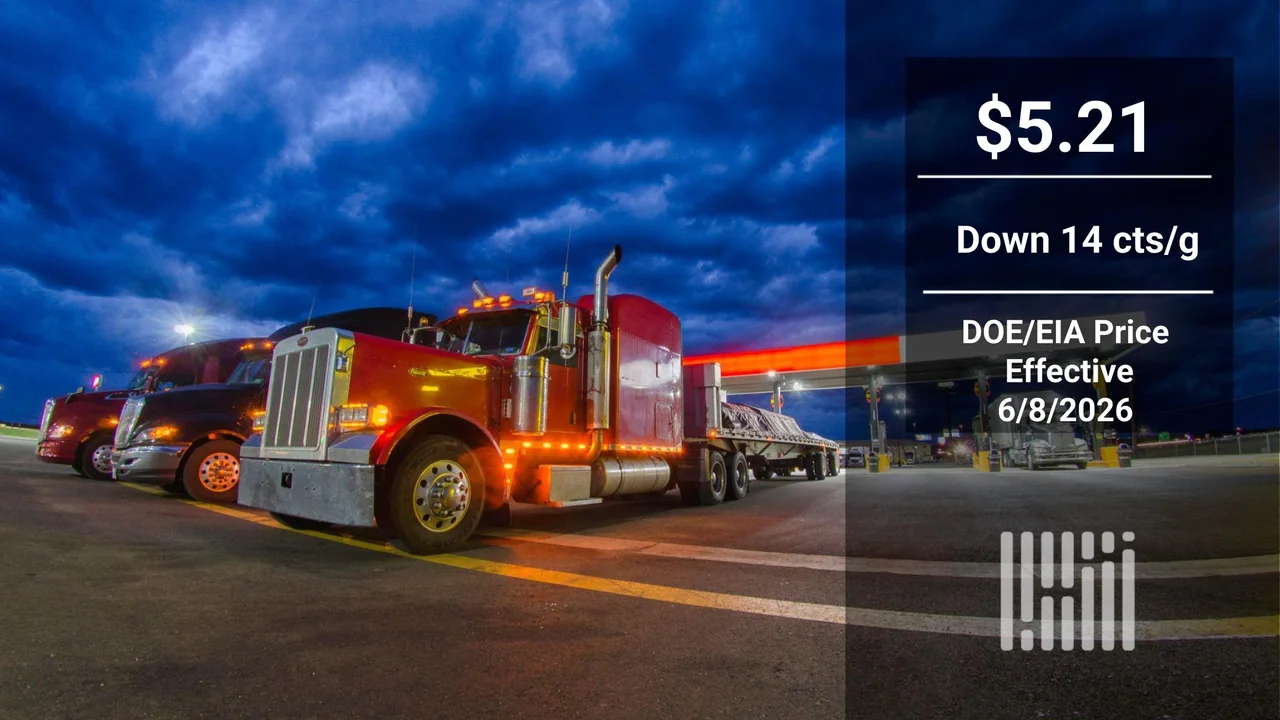
Diesel prices have continued their downward trend, with the benchmark price used for most fuel surcharges falling to $5.21/gallon, its lowest level since March. This marks the fifth straight week of decline, with a total drop of 43 cents/gallon over that period. The decrease in diesel prices has been steady, with no signs of reversal yet.
The Department of Energy/Energy Information Administration average weekly retail diesel price is closely watched as a sign of potential global trends. With total inventories of 1.573 billion barrels, the lowest in more than two years and the tenth straight week they had declined, the data suggests that the market may be facing a supply shock similar to what occurred during COVID-19.
The disconnect between the DOE/EIA price and the daily AAA average retail diesel price is also noteworthy. While the DOE/EIA price has fallen, the daily AAA average retail diesel price remains at $5.317/gallon, indicating that there may be other factors at play in the market.

Ultra low sulfur diesel on the CME commodity exchange posted a recent peak settlement of $3.8481/g on June 3, but its settlement Monday was $3.5999/g, and the market was trending lower Tuesday morning. This suggests that traders are becoming increasingly bearish on the market.
One of the loudest voices warning about a 'tank bottoms' scenario is Jeffrey Currie, former head of commodity research at Goldman Sachs. He believes that paper markets are 'entirely disconnected from the physical markets,' and that the supply shock is almost equal to the demand shock during COVID-19.
Currie's message has been consistent for several weeks: what matters are the molecules, not paper markets that increasingly are bearish. He notes that global crude benchmark Brent is now below $90/barrel, but crude delivered in some parts of the world is north of $150/b and product prices like jet or diesel are more than $200/b.
But despite the low price of oil, traders are not buying forward barrels to be delivered several months from now. This is evident in the forward curve, which shows that traders are becoming increasingly risk-averse.
The question on everyone's mind is why aren't traders buying forward barrels when they know the price will presumably be higher? The answer lies in market uncertainty and the fear of a potential 'tank bottoms' scenario.
As the market continues to navigate this uncertain period, it's clear that diesel prices are not going to reverse their downward trend anytime soon. With five straight weeks of decline under their belt, traders would do well to keep a close eye on the market and be prepared for any unexpected changes.
While oil futures may be mispriced, traders are not buying forward barrels due to market uncertainty.