
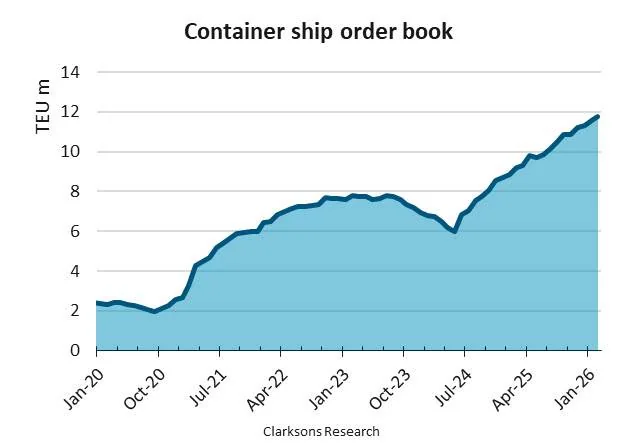
The container ship market has defied expectations by continuing to expand despite rising trade policy uncertainty and falling freight rates. The latest figures from BIMCO reveal that the container ship order book has reached a record high of 1,350 ships with a combined capacity of 11.8 million TEU. This represents a significant increase from previous years, with the total order book growing by 28% year-on-year to reach this new milestone.
The growth in global container volumes has been a key driver behind this expansion, with volumes growing 4.7% year-on-year according to Container Trade Statistics. Despite concerns about increasing trade protectionism due to US import tariff increases, the global average container freight rate fell an estimated 13% year-on-year in 2025.
The record high order book is also driven by a shift towards larger ships dominating the market. According to BIMCO's Chief Shipping Analyst, Niels Rasmussen, 436 ships with a capacity of 12k TEU or more are on order and make up 65% of the total TEU on order. This points to a trend where larger ships will replace smaller ones throughout the global network of services.
However, it's worth noting that the growth in the order book for smaller ships has been significantly faster than for larger vessels. The order books for ships with capacities ranging from 0-3k TEU, 3-6k TEU, and 6-8k TEU have all more than doubled over the past year, whereas the rest of the order book has grown by only 17%. This suggests that there is still strong demand for smaller vessels in the market.
Despite this growth, the combined order book of the three smaller segments currently makes up only 16% of their current fleet capacity. However, as 29% of the capacity in these segments is provided by ships 20 years old or older, recycling of older ships could potentially match or exceed the number of new ships being delivered from the order book in the coming years.
The increasing number of very large ships on order is also driving a significant change in the container fleet's ownership structure. Non-operating owners controlled 43% of the capacity at the beginning of the 2020s, but this has since fallen to 36%. As non-operating owners only account for 24% of the capacity on order, it's likely that their control will continue to decline.
The implications of this trend are significant. According to Rasmussen, a total of 11.8 million TEU is scheduled to be delivered between 2025 and 2029. Even if all ships currently 22 years old or older are recycled before the end of 2030, the fleet would continue to grow at an average rate of 6.1% per year, which could create a challenging supply/demand environment for liner operators.
As the container market continues to evolve, it's clear that the trend towards larger ships and declining non-operating owner control will have significant implications for the industry. With the record high order book set to continue growing in the coming years, it's essential for companies to be prepared for the challenges and opportunities that this presents.
The growth of the container ship market also highlights the importance of recycling older vessels. As the demand for new ships continues to rise, finding ways to extend the life of existing vessels will become increasingly crucial. The industry will need to adapt to this trend in order to minimize waste and reduce its environmental impact.
In conclusion, the record high container ship orders are a testament to the ongoing growth of the global container market. As the industry continues to evolve, it's essential for companies to be aware of the trends and challenges that lie ahead.
The increasing number of very large ships on order is driving a significant change in the container fleet's ownership structure, with non-operating owners' control over capacity expected to continue declining.