
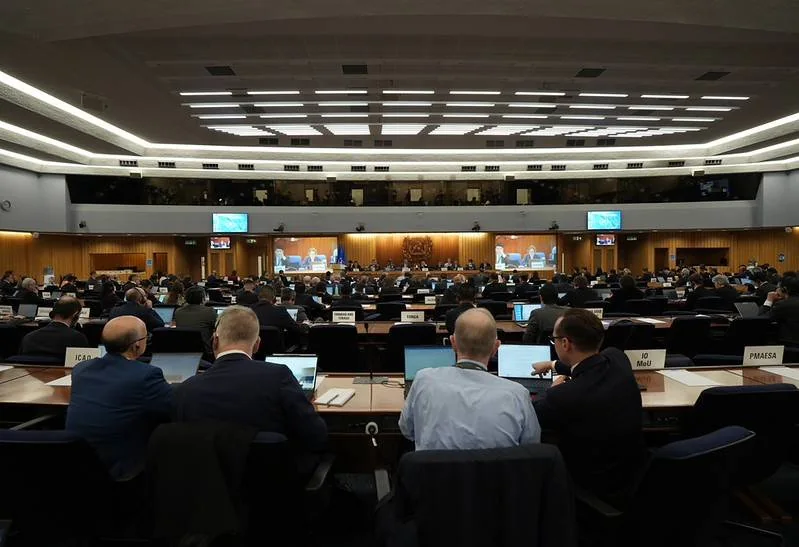
The International Maritime Organization's (IMO) Sub-Committee on Ship Systems and Equipment recently held its 12th session, where significant progress was made on lifeboat air supply requirements. The amendments proposed by the IMO aim to enhance the safety of partially enclosed lifeboats installed on or after January 1, 2028. These lifeboats will need to be equipped with a means of supplying sufficient air to maintain CO2 concentrations below 5,000 ppm for the full number of occupants, even with entrances closed.
The new proposed section 4.5.5 requires compliance with one of three alternatives: a ventilation system providing at least 5 m³/h per person for 24 hours, or ventilation openings with a total cross-sectional area of at least 0.015 m² per person located in opposite directions and widely spaced. These requirements are designed to prevent stratification and ensure adequate air supply for occupants.
The proposed amendments also introduce new testing requirements for partially enclosed lifeboats, including prototype testing and verification of ventilation systems. This will help ensure that these lifeboats meet the required standards for safety and efficacy.
The IMO has invited Member States to submit technological evidence to determine the appropriate figure for ventilation openings and their optimal location. This will allow for further refinement of the proposed amendments and ensure that they are based on the latest scientific research and testing results.
Additionally, the correspondence group is tasked with progressing draft consequential amendments to MSC.1/Circ.1630/Rev.3 inter-sessionally. These amendments aim to address any potential issues or concerns raised during the testing process.
The progress made at the IMO session is a significant step forward in improving lifeboat safety and reducing the risk of accidents at sea. The proposed amendments demonstrate the organization's commitment to ensuring that maritime vessels meet the highest standards of safety and efficacy.
Furthermore, the IMO has also finalized revised guidelines for the maintenance and inspections of fixed carbon dioxide fire-extinguishing systems. These guidelines aim to ensure that these systems are properly maintained and functioning correctly to prevent fires on board.
The session also saw the introduction of new guidelines for the design, testing, and approval of water mist lances. These guidelines aim to improve the safety and effectiveness of these systems in preventing fires on board.
Finally, a new SOLAS regulation II-2/7.11 has been established on portable infrared thermal imagers. This regulation aims to ensure that these devices are properly designed, tested, and approved for use on board maritime vessels.
The proposed amendments to the LSA Code aim to improve lifeboat safety by ensuring sufficient air supply for occupants in emergency situations.