


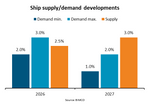
The dry bulk supply and demand balance is expected to remain stable in 2026 and weaken in 2027, according to BIMCO estimates. 2 percentage points, driven by stimulus policies and strong investment in technology and AI.
China's economic outlook has also improved due to higher stimulus and its trade agreement with the US, but a gradual slowdown is still expected. Freight rates are forecast to remain strong in 2026, but could start to slip in 2027, reflecting weaker market conditions.
The capesize segment is expected to outperform others, supported by low fleet growth and growing sailing distances. Ship demand is projected to grow 2-3% in 2026 and 1-2% in 2027, driven by stronger grain and minor bulk shipments.

However, a weak outlook for iron ore and coal volumes limits gains. 5% in 2026 and 3% in 2027, with fleet growth accelerating and ship recycling increasing.
Sailing speeds are forecast to fall slightly in both years, except for the capesize segment. The potential full return of ships to the Red Sea poses a significant downside risk to the demand outlook, equivalent to a 2% decrease in tonne mile demand due to reduced average sailing distances.
The global economy's growth and changing market conditions will continue to impact the dry bulk shipping industry. As the industry navigates these shifts, it is essential to monitor freight rates and adjust strategies accordingly.


