


A recent proof of concept test by IQUA Robotics has successfully demonstrated the viability of using Autonomous Underwater Vehicles (AUVs) for naval inspection tasks. The ESCABVENTS project, developed in collaboration with Zamakona Yards shipyard, aimed to improve efficiency and safety in preventive maintenance of vessels. By leveraging AUV technology, the project seeks to reduce the reliance on divers or tethered robots, which are often limited by their range and maneuverability.
The initiative is part of the Sail2future project, funded by the European Union – NextGenerationEU through the PERTE NAVAL aid managed by the Spanish Ministry of Industry, Trade and Tourism, within the Recovery, Transformation and Resilience Plan. This funding supports the development of innovative technologies that can drive growth and competitiveness in the maritime sector. The use of AUVs for hull inspection has the potential to transform maintenance practices, enabling vessels to stay at sea for longer periods while reducing costs.
The research has focused on overcoming the limitations of current methods, which often rely on divers or tethered robots (ROVs). These traditional approaches can be time-consuming and expensive, with limited accessibility to certain areas of the hull. The use of an autonomous vehicle like the Sparus II AUV allows for systematic scanning without direct intervention from an operator in piloting, enabling more efficient data collection and analysis.
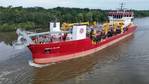
Experimental tests, carried out in collaboration with Zamakona Yards shipyard and Reparaciones Navales Canarias staff, have been crucial to validating the system in real port environments. These campaigns involved collecting multiple datasets on four vessels of different types, including fishing, research, and defense ships. The results show that it is possible to obtain 3D reconstructions with centimetric resolution, facilitating the identification of corrosion, marine fouling (biofouling), or paint damage.
The system's effectiveness has been demonstrated in uniform sections of the hull, but challenges remain in areas of complex geometry, such as the stern (propellers and rudders). Acoustic reflections complicate automatic tracking in these areas, limiting the accuracy of the AUV's navigation. Additionally, difficulties have been detected in taking images of the sides of the vessel, where high light contrast causes underexposure.
Future technical steps will focus on addressing these challenges and improving the system's capabilities. By doing so, IQUA Robotics aims to expand the use of AUVs for autonomous ship hull inspection beyond industrial maintenance to port security applications. This could enable the detection of threats and contraband adhered below the waterline, enhancing maritime security.
The success of this project has significant implications for the maritime industry, enabling more efficient and safe maintenance practices. As the global fleet continues to grow, the need for innovative technologies like AUVs becomes increasingly pressing. By embracing this technology, shipowners and operators can reduce costs, improve vessel availability, and enhance overall safety.
The use of AUVs for hull inspection also raises questions about the future of human intervention in maintenance tasks. As these systems become more sophisticated, it is likely that their role will evolve from purely data collection to more complex decision-making processes. This could lead to a shift towards more autonomous maintenance practices, with humans playing a supporting role.
The development and deployment of AUVs for autonomous ship hull inspection represent an exciting milestone in the evolution of maritime technology. As this technology continues to mature, it is likely that we will see widespread adoption across the industry, driving improvements in efficiency, safety, and environmental sustainability.
The use of AUVs for autonomous ship hull inspection has significant implications for the maritime industry, enabling more efficient and safe maintenance practices.