
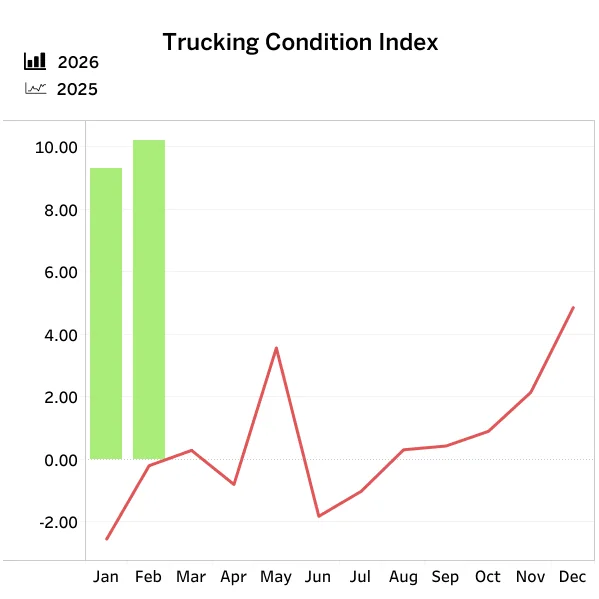
FTR's Trucking Conditions Index (TCI) has reached a four-year high, with February's reading of 10.2 representing nearly a full point month-over-month increase. This surge in the index is largely driven by continued strengthening in freight rates, which have become a key factor in determining the overall health of the trucking industry. The TCI aggregates various industry factors, including freight volumes, rates, capacity, fuel prices, and financing costs, to provide a comprehensive picture of market conditions. As a result, carriers are currently experiencing favorable operating conditions, with double-digit readings signaling significant market shifts.
The trucking analytic firm's expectations for March results are more cautious, however, due to the recent surge in diesel prices. This sharp increase in fuel costs could push the TCI into negative territory and make it challenging for carriers to maintain their current gains. Despite this uncertainty, preliminary analysis suggests that strong rates and tight capacity may still contribute to a marginally positive reading.
The record surge in diesel prices during February dealt a significant blow to carriers, but FTR's vice president of trucking notes that the near-term market is far more difficult to forecast due to extreme volatility in fuel prices. The recent ceasefire in the Middle East and uncertainty over the spot market's response to falling diesel prices add to the complexity of predicting future trends.

FTR's analysis highlights how much capacity has tightened in the industry, with the market's reaction to weather disruptions and fuel price swings underscoring this trend. As carriers navigate these challenging conditions, they will need to carefully balance their rates and volumes to ensure long-term sustainability.
The key question going forward is whether freight volumes will be strong enough to drive further rate increases or if carriers will simply maintain recent gains. This depends on various factors, including the spot market's response to falling diesel prices and the overall demand for trucking services.
FTR's TCI combines five core metrics into a single measure of trucking market conditions, providing a comprehensive picture of the industry's health. Positive readings indicate favorable operating conditions, while negative readings signal deterioration. Values near zero suggest a neutral environment, while double-digit readings point to significant market shifts.

The impact of favorable freight rates on carriers' operating conditions cannot be overstated, as they have become a key driver of the trucking industry's performance. With rates at historic highs, carriers are in a strong position to negotiate better deals with shippers and maintain their market share.
As the trucking industry continues to navigate these complex trends, it is essential for carriers to monitor their costs and revenues closely to ensure they remain competitive. This may involve adjusting their rates, volumes, or other operational strategies to stay ahead of the curve.
The TCI's four-year high in February serves as a reminder that the trucking industry is facing significant challenges and opportunities. As carriers navigate these uncertain conditions, they will need to be agile and responsive to changing market trends to remain successful.

The strong showing in February's TCI reading highlights the significant impact of favorable freight rates on carriers' operating conditions.