The maritime industry is witnessing a significant shift towards autonomous technologies, with Fairbanks Morse Defense (FMD) taking a leading role in this revolution. The company has recently introduced AutoHook, a groundbreaking fully autonomous vessel recovery interface designed to support unmanned surface vehicles (USVs) and other assets requiring zero human intervention. This innovative system is poised to transform the way naval forces operate, making it faster, safer, and more efficient.
The compact and lightweight form factor of AutoHook is specifically designed for interoperability across allied fleets in demanding maritime conditions. By eliminating the need for an additional cradle during loading and unloading, this system streamlines the recovery process, reducing the risk of accidents and injuries to personnel. This is particularly significant given the growing demand for autonomous vessels in naval operations.
Unlike current autonomous solutions that struggle to meet operational demands beyond Sea State 2, AutoHook successfully achieved operational acceptance at Sea State 4. The system's ability to operate in challenging conditions underscores its reliability and effectiveness in real-world scenarios. By prioritizing safety above all else, FMD has set a new standard for autonomous vessel recovery systems.
AutoHook is engineered with the evolving mission profiles of naval forces in mind, aligning seamlessly with NATO operational standards. This ensures that allied maritime forces can deploy this system quickly and effectively, without requiring costly modifications to existing vessels. The compact design also makes it an attractive option for smaller naval vessels or those with limited resources.
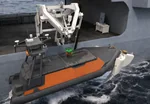
The AutoHook clamp-on-davit wire unit mounts easily, eliminating the need for winches or davit modifications. This not only saves time but also reduces the logistical burden on naval operations. Moreover, the integrated thrusters, onboard control, vision, and power contained within a single minimal-footprint unit ensure seamless integration with existing vessels.
One of the most significant advantages of AutoHook is its ability to achieve stable tracking of dynamic targets using its onboard vision system and integrated thrusters. This eliminates crew exposure while increasing speed, reliability, and operational efficiency. The autonomous operation of the system is ideally suited for the growing unmanned fleets being developed by navies worldwide.
The use of AI-powered autonomous vision systems like Vestdavit's in AutoHook represents a significant step forward in maritime operations. By determining and tracking the precise location of the rescue boat in real-time, this technology reduces the risk of accidents and increases the effectiveness of naval operations. As the demand for autonomous vessels continues to grow, innovations like AutoHook will play a critical role in shaping the future of naval defense.
The introduction of AutoHook by FMD marks an exciting new chapter in the development of autonomous vessel recovery systems. With its cutting-edge technology and compact design, this system is poised to revolutionize the way naval forces operate, making it faster, safer, and more efficient. As the maritime industry continues to evolve, innovations like AutoHook will be essential for ensuring the success of allied naval operations.
The potential impact of AutoHook on naval operations cannot be overstated. By eliminating the need for manual connections and reducing the risk of injuries during operations, this system has the potential to save lives and reduce costs. As the use of autonomous technologies becomes increasingly widespread in the maritime industry, innovations like AutoHook will play a critical role in shaping the future of naval defense.