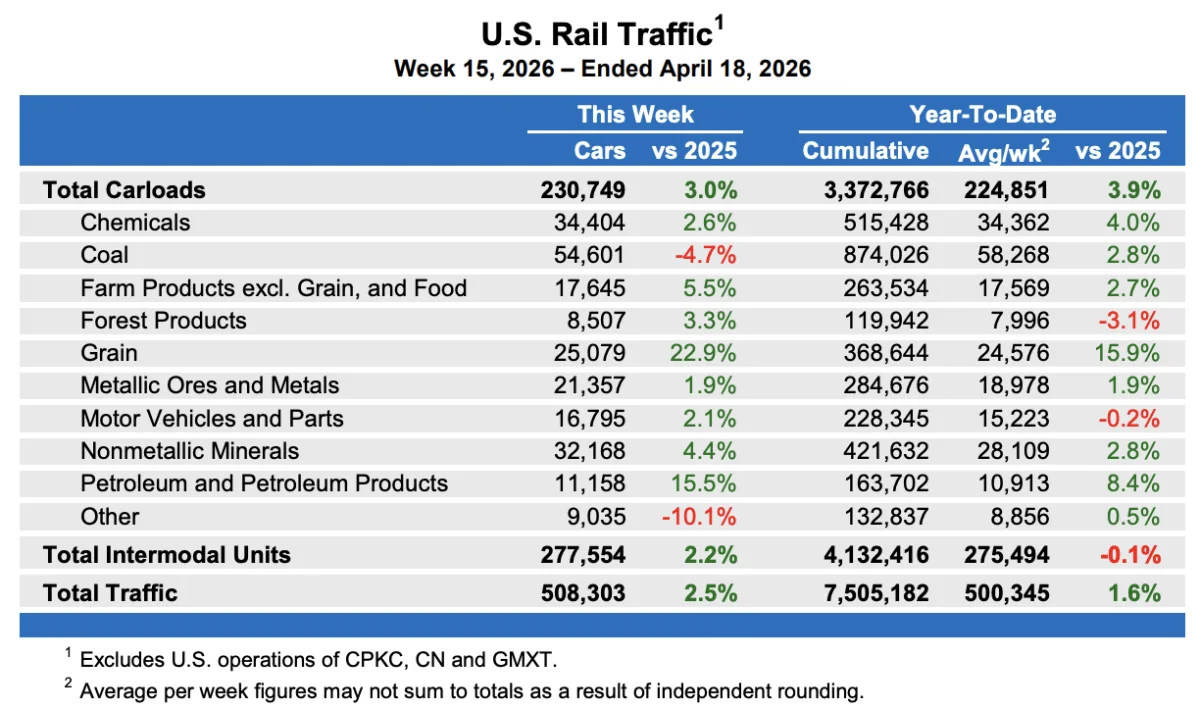
Intermodal rail freight has seen a significant rebound in recent weeks, with total carloads on U.S. railroads reaching 508,303 and intermodal units increasing by 2.5% for the week ending April 18.
This growth is largely driven by an increase in grain shipments, which have jumped by 22.9% compared to the same period last year.
The rebound in intermodal freight is also being fueled by a decline in miscellaneous carloads, which have dropped by 10.1%.

Despite this growth, total combined traffic on U.S. railroads remains narrowly ahead of 2025 levels.
For the first 15 weeks of 2026, U.S. railroads reported cumulative volume of 3,372,766 carloads, better by 3.9%, and 4,132,416 intermodal units, a decline of 0.1% y/y.
The strong rebound in intermodal freight is also being driven by an increase in North American volume on 9 reporting U.S., Canadian, and Mexican railroads.

Weekly North American volume on these railroads totaled 339,795 carloads, up 4.7% from a year ago, and 364,495 intermodal units, an improvement of 2.9%.
Total combined traffic was 704,290 carloads and intermodal units, up 3.8 percent.
Year-to-date volume was 10,336,147 carloads and intermodal units, an increase of 1.9% from 2025.
The rebound in intermodal freight is a positive sign for the industry, but it also highlights the need for continued investment in infrastructure and technology to support future growth.
The strong rebound in intermodal rail freight is a positive sign for the industry, but it also highlights the need for continued investment in infrastructure and technology.