

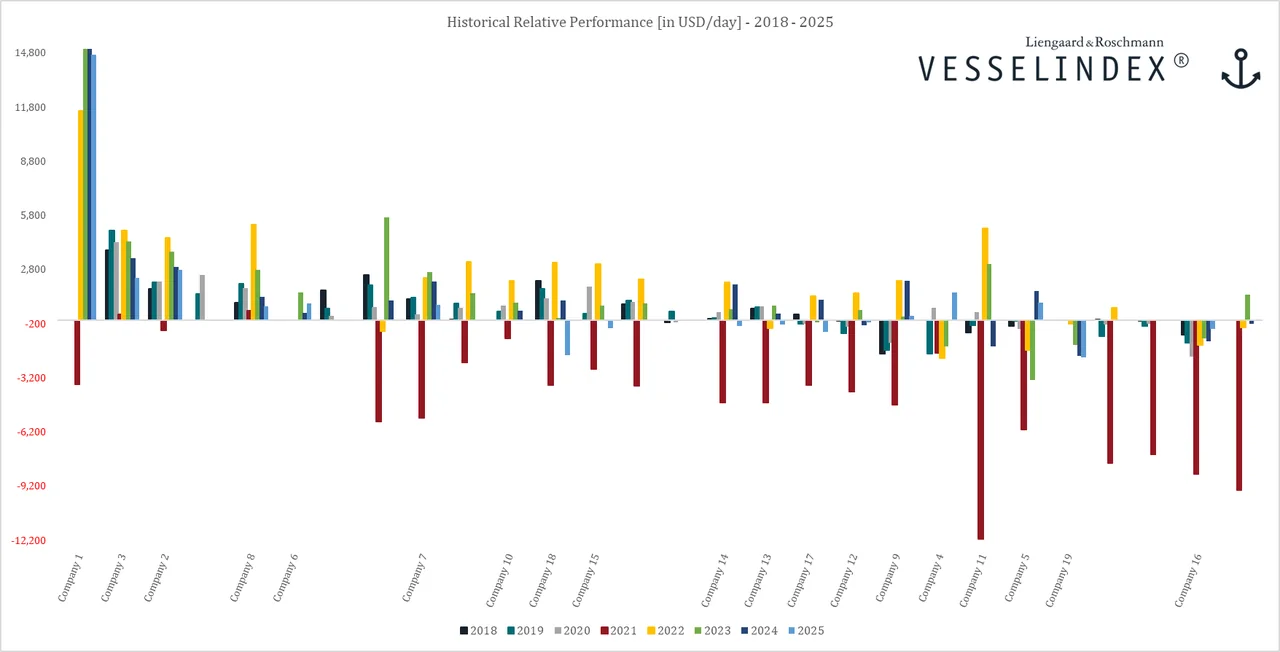
The dry bulk market has experienced a shift in performance, with fewer companies outperforming when adjusted for fleet earning potential. According to the Vesselindex Performance Report, TCE earnings have declined to 1.7% in 2025, compared to 5.3% in 2024. This normalization of performance suggests a softer market environment, where traditional measures of success are being reevaluated.
The report also highlights the importance of long-term earnings consistency over point-in-time asset values. As fleets continue to renew and upgrade, 'steel value' becomes less reliable as an indicator of underlying value creation. Instead, companies that consistently generate earnings and cash flow from their fleets emerge as more valuable propositions.
A small group of companies continues to demonstrate strong commercial execution, while several others show improvements compared to previous years. However, the dispersion within the Capesize segment remains pronounced, with differences between companies remaining significant.
The Vesselindex Performance Report aims to establish a common industry framework for evaluating TCE performance and promoting greater transparency in earnings and operational reporting. By isolating the relationship between fleet composition and commercial results, the report provides investors and analysts with a more accurate basis for comparison and decision-making.
As fuel spreads narrowed versus 2024, the contribution from scrubber economics to TCE performance has reduced. This decrease highlights the impact of changing market conditions on the dry bulk sector's profitability.
The compressed TCE performance landscape with fewer extreme outperformers suggests that the industry is moving towards a more normalized performance environment. However, this normalization also raises questions about the value creation potential of individual companies and the broader market.
Investors and analysts must reevaluate their approach to valuing dry bulk companies, taking into account long-term earnings consistency rather than point-in-time asset values. The ability to consistently generate earnings and cash flow from a fleet becomes a more meaningful measure of performance and value creation.
The Vesselindex Performance Report provides a benchmark for transparency in performance reporting, encouraging industry stakeholders to prioritize commercial performance over asset values. By doing so, the report aims to promote a more accurate and informed market perception of the dry bulk sector's performance.
As the industry continues to evolve, it is essential to focus on long-term earnings consistency and cash flow generation. Companies that can consistently deliver strong commercial results will be better positioned for success in the face of changing market conditions.
The industry's focus on long-term earnings consistency is crucial for valuations.