

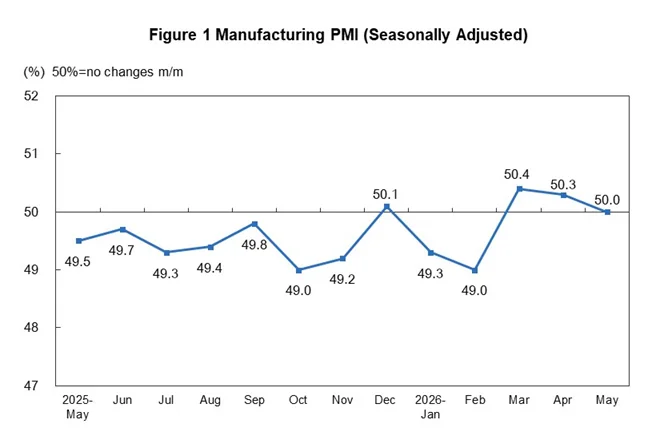
China's manufacturing industry experienced a significant downturn in May, with the purchasing managers' index (PMI) falling to 50.0%, a decrease of 0.3 percentage points from the previous month.
This decline is concerning as it suggests that the manufacturing sector is facing challenges, including inflationary effects and supply chain disruptions.
The PMI is usually considered expansion when above 50% but contraction when below that threshold.

According to data from the National Bureau of Statistics, the index for large enterprises was 51.1%, an increase of 0.9 percentage points from the previous month, while medium- and small-sized enterprises saw a decline in their PMI.
The decline in manufacturing activity could be a worrying sign of things to come, especially given China's growing exports, which increased by 6.1% in 2025.
However, analysts note that the export growth remains steady despite the decline in the manufacturing index, suggesting that other sectors may be compensating for the slowdown.

Inflationary effects on manufacturers have been seen as a contributing factor to the decline, with the conflict in the Strait of Hormuz pushing up the cost of raw materials.
The monthly Purchase Price Index rose significantly prior to the outbreak of the Iran war in February, only to settle at 60.5 in May.
The sub-indices that make up the manufacturing PMI also indicate a slowdown in production and new orders, with the supplier delivery time index extending further compared to the previous month.
Overall, the decline in China's manufacturing index is a sign of a slowing economy and highlights the need for manufacturers to adapt to changing market conditions.
A decline in the manufacturing index can have far-reaching implications for global trade and economic growth.