

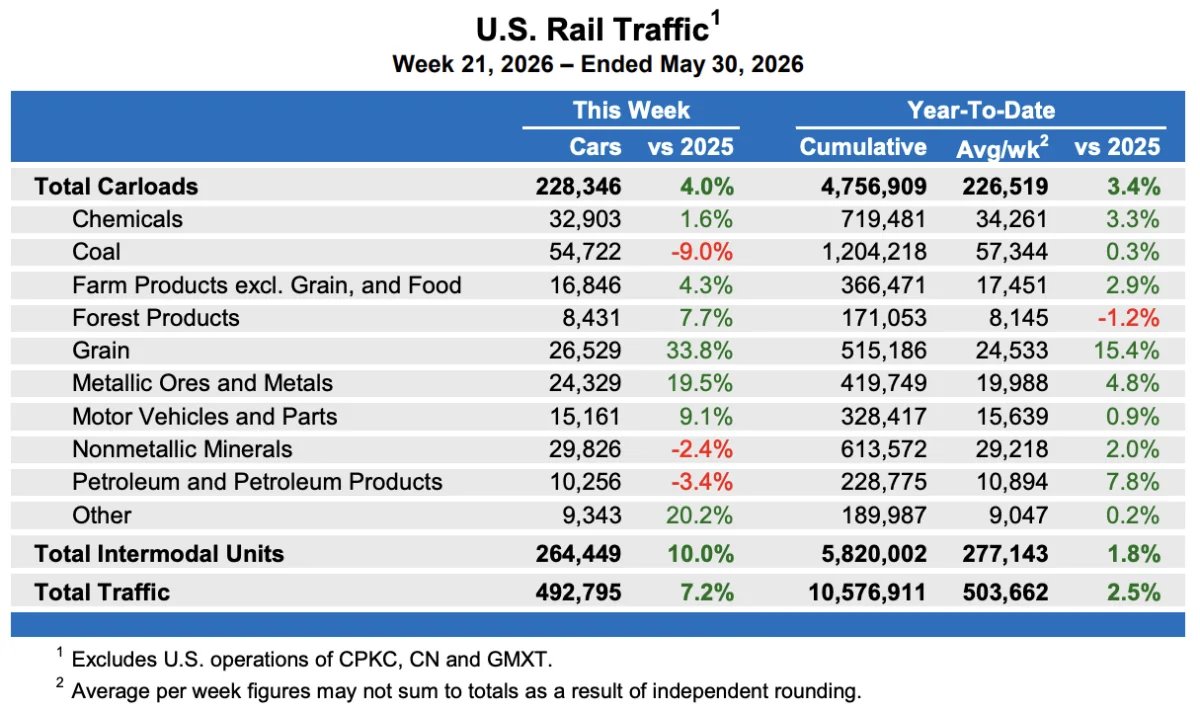
Rail freight has seen significant growth over the past year, with US railroads reporting a 7.2% increase in carloads and intermodal units for the week ending May 30.
This growth is largely attributed to shifts by shippers who are facing challenges in the trucking market, including tender rejections, high fuel costs, and rising rates.
The environment for motor carriers has also improved, with a capacity squeeze resulting from enforcement efforts that have targeted non-English speaking drivers, sketchy trucking schools, and chameleon carriers that reemerge after accidents.
Commodity shipments improved by 4% to 228,346 carloads, while intermodal volume was better by 10% y/y at 264,449 containers and trailers.
Grain was a leader in this growth, with an increase of 33.8%, followed by metallic ores and metals, up 19.5%, and motor vehicles and parts, up 9.1%.
Notably, miscellaneous unidentified ladings classified as Other were up 20.2%, indicating a growing demand for less common commodities.

Coal was the only decliner in this group, down 9%, along with petroleum and petroleum products, which fell 3.4%, and nonmetallic minerals, which declined 2.4%.
For the first 21 weeks of this year, cumulative US volume was 3.4% better than 2025, while 5,820,002 intermodal units improved 1.8%. Total combined traffic was ahead by 2.5%.
North American rail volume for the week on 9 reporting U.S., Canadian and Mexican railroads increased by 2.7% to 336,920 carloads from a year ago.
The growth of intermodal is a positive sign for the industry, but challenges remain.