The global container shipping market has seen a significant shift in recent weeks, with average spot rates declining across most major trade lanes. This decline is largely attributed to an increase in offered capacity, which has put downward pressure on prices. As a result, carriers are struggling to maintain profitability in these markets.
The Far East to US West Coast route has been particularly affected, with spot rates falling to $1,889 per FEU as of February 19, 2026. This decline is consistent with the broader trend of decreasing spot rates across most major trade lanes. The increase in offered capacity has made it challenging for carriers to maintain prices, leading to a decrease in revenue. This could have significant implications for carriers operating on this route.
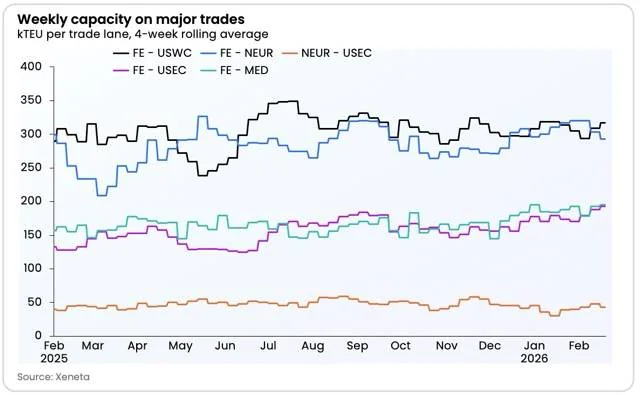
In contrast, the Far East to North Europe route has seen an increase in offered capacity, with a 3.4% week-on-week decline. However, spot rates have continued to fall, indicating a weaker market. This suggests that carriers are struggling to maintain prices in this region, despite increased capacity. The implications of this trend for carriers operating on this route will be closely watched.
The situation is expected to worsen in 2026, with many analysts predicting an oversupply of containers and rising competition among carriers. The return of services to the Red Sea is also expected to exacerbate this issue, as it will increase the number of vessels competing for cargo. This could lead to a significant decrease in spot rates and further pressure on carriers.
The security situation in the Red Sea is also a major concern, with rising tensions between the US and Iran potentially leading to increased attacks on merchant ships. If this happens, it could delay the return of container shipping services to the Red Sea and increase the risk of overcapacity for carriers. This would have significant implications for the market as a whole.
Despite these challenges, some analysts believe that the military posturing and rhetoric from political leaders could slow down plans to resume Red Sea transits. If this happens, it could delay the return of container shipping services to the region and ease the pressure on carriers. This would be a positive development for the market, but it is unclear whether this will happen.
The data highlights the complexity of the current market trends. The average spot rates for each route are as follows: $1,889 per FEU for Far East to US West Coast, $2,688 per FEU for Far East to US East Coast, and $2,251 per FEU for Far East to North Europe. These rates are significantly lower than those seen in previous months.
The offered capacity data also provides insight into the market trends. The 4-week rolling average shows an increase in offered capacity across most major trade lanes, with the exception of the Far East to North Europe route. This increase in capacity is putting downward pressure on prices and making it challenging for carriers to maintain profitability.
In conclusion, the container shipping market is experiencing a complex mix of trends, with some routes seeing falling spot rates and others facing increased capacity. The implications of these trends will be closely watched by carriers and analysts alike, as they navigate the challenges of the current market.
{'paragraphs': ['The decline in spot rates across most major trade lanes has significant implications for carriers operating on these routes. As prices fall, carriers may struggle to maintain profitability, leading to reduced investments in new vessels or capacity expansions.', 'The increase in offered capacity is also a concern for carriers, as it puts downward pressure on prices and reduces revenue. This could lead to a decrease in market share for carriers that are not able to adapt quickly enough to the changing market trends.', 'Overall, the container shipping market is experiencing a period of significant change and uncertainty. As carriers navigate these challenges, they will need to be agile and responsive to changes in the market in order to remain competitive.', {'paragraphs': ['The impact of the current market trends on carriers will be closely watched by analysts and industry experts. As the situation continues to evolve, it is likely that we will see further changes in spot rates and offered capacity across most major trade lanes.', {'paragraphs': ['In conclusion, the container shipping market is experiencing a complex mix of trends, with some routes seeing falling spot rates and others facing increased capacity. The implications of these trends will be closely watched by carriers and analysts alike, as they navigate the challenges of the current market.']}]}]}
The container shipping market is experiencing a complex mix of trends, with some routes seeing falling spot rates and others facing increased capacity.