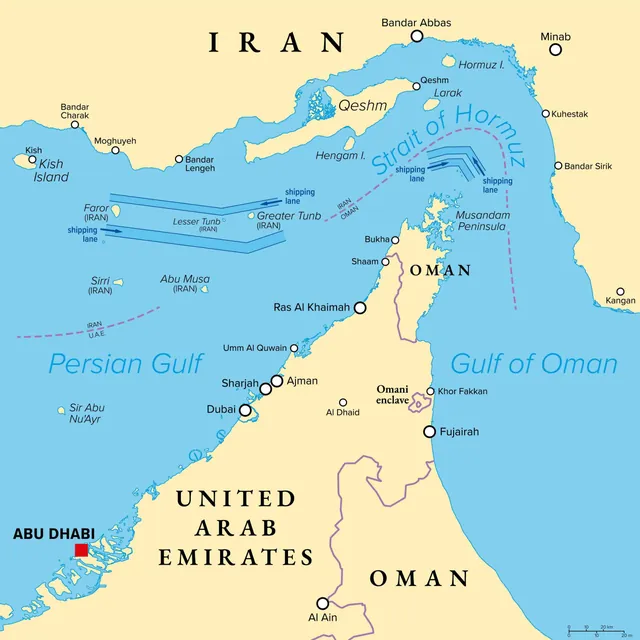


The situation in the Strait of Hormuz has taken a turn for the worse as the U.S. threatens to escalate attacks against Iran, resulting in a shutdown of key shipping lanes that are now causing congestion at regional ports. The Persian Gulf shipping lane is effectively closed, and with it, the narrow passage to the Persian Gulf is also blocked. This has significant implications for the global supply chain, with many countries relying on this route to import and export goods.
The impact of the shutdown is being felt across the region, with six tanker vessels in or near the Strait of Hormuz coming under attack early this week. The situation is driving significant logistics disruptions in the area, which could start to be felt more broadly if the conflict stretches on. The U.S.-Israel strikes on Iran and subsequent Iranian retaliation are also exacerbating the crisis.
The Strait of Hormuz is a critical waterway that accounts for about 20% of the world's crude oil movements. However, it's not just oil that's affected - 80% of Iran's output goes to China, making this conflict have significant implications for global trade. Tehran has a new freight-only rail line to China that opened regular operations in 2025 as a bypass to the Strait of Hormuz, but it's unknown what capacity the route can support.
The situation is being closely watched by shipping companies and analysts, with many predicting that the conflict will have far-reaching consequences for the global supply chain. DP World briefly suspended operations at the container port of Jebel Ali in Dubai after an aerial interception caused a fire there on Saturday night but reopened on Monday.
Major carriers are managing security risks by diverting vessels, cancelling sailings and suspending new bookings. Hapag-Lloyd and MSC suspended bookings out of Persian Gulf ports and from all origins to these ports - including Oman and United Arab Emirates ports on the Gulf of Oman side of the strait because of their proximity.
The cancelled sailings mean gulf-bound containers are starting to pile up and threaten congestion in India. Carriers are diverting containers already in transit to alternative destinations in the area, with most volumes likely to be offloaded at the major Far East transshipment hubs in Singapore, Malaysia and Sri Lanka.
Annual container traffic through the strait totals 2% to 3% of global volumes, but estimates suggest that up to 10% of effective capacity may be lost due to the stranded vessels. The longer these vessels and equipment are out of circulation, the more likely that reduction will be felt in terms of available capacity and equipment out of the Far East.
The situation is also having a knock-on effect on fuel costs, with climbing prices potentially pushing rates up on non-gulf lanes. CMA CGM introduced an emergency surcharge of $3,000 per forty foot equivalent unit (FEU) for containers heading to the gulf, and other carriers are also applying fees for diverted bookings.
The Iran crisis is a complex and rapidly evolving situation that will continue to have significant implications for global trade and commerce. As the situation continues to unfold, it's likely that we'll see further disruptions and changes in the shipping industry.
Maersk and CMA CGM are among the major carriers that have suspended sailings and bookings due to the security risks posed by the conflict. The Suez Canal route is also being avoided, with many shipping companies diverting around Africa instead of taking the traditional route through the Mediterranean.
The Iran situation will likely push a full Red Sea return farther off again, according to analysts. This means that shipping contracts and negotiations may be affected, as the industry adapts to the changing security landscape.
The Iran crisis is causing congestion and disruption to the global supply chain, with regional ports struggling to cope with the increased security risks.