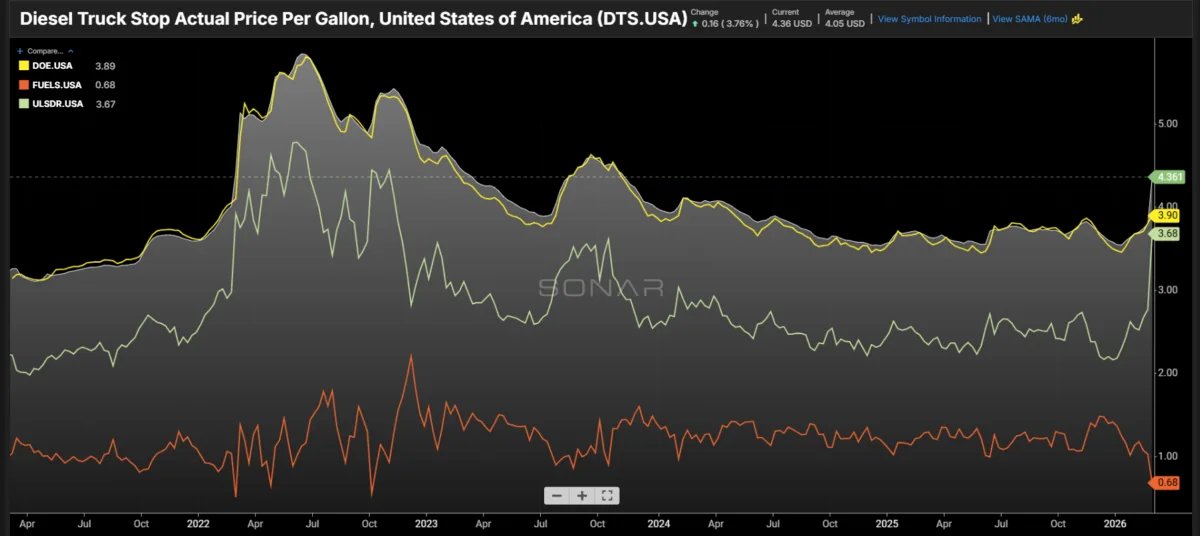
The latest disruption in the oil market has seen wholesale diesel prices jump more than 30% last week, while retail prices increased by over 14%. This rapid price change may have a greater impact on the transportation industry than the actual cost increase. Despite this, shippers and carriers alike are feeling the pinch of rising fuel costs.
Fuel typically accounts for around 20-25% of the total cost of truckload transportation, making it a critical component of operating expenses for carriers. For shippers, rapid increases in fuel prices can be devastating to budgets, while for carriers, managing fuel costs is essential to maintaining profitability.
The current disruption in the oil market is the most significant since Russia's invasion of Ukraine in early 2022 and marks the first large-scale disruption since OPEC voluntarily constrained supply in the summer of 2023. This event was relatively short-lived, as prices moderated later that fall.

Most trucking carriers recover fuel costs through a fuel surcharge tied to the weekly average diesel price published each Monday by the DOE. The surcharge table assumes a fuel efficiency of around 6.5-7 miles per gallon and typically begins at $1.00-$1.50 per gallon, increasing incrementally as diesel prices rise.
However, many large fleets have purchasing agreements with fuel suppliers that allow them to buy fuel in bulk at or slightly above the wholesale price. While this may seem like an arbitrage opportunity, carriers use the spread to offer more competitive pricing when the market is balanced and capacity is relatively loose.
When wholesale prices rise faster than the average retail price, it compresses the buffer created by the spread between retail and wholesale diesel. This means that carriers have less flexibility to pass fuel costs through effectively, while also reducing profitability.

The speed of the change is particularly important, as pricing teams typically adjust rates based on historical data. Many contract rates were likely structured assuming a spread closer to $1.20 per gallon, which may not be improving profitability and could actually be reducing it.
Spot rates tell a different story, with smaller fleets and owner-operators facing tighter costs due to their lack of volume to secure fuel purchasing agreements. Their costs are tied more closely to retail fuel prices, which are passed through to customers more directly and often more quickly.
The trucking market appears to be transitioning towards a tighter environment following a strong holiday season and the disruption caused by Winter Storm Fern. Rising fuel costs have contributed to recent increases in spot rates, and these pressures could persist as carriers continue to refuel at higher prices.