
S. port executives on Capitol Hill. S.
maritime strategy. -flag vessels globally competitive to rebuilding domestic shipbuilding capacity and training a new maritime workforce. The legislation is co-sponsored by Sen.
), and Rep. ) and Rep. ).
“The maritime industry matters to our entire economy,” said Kelly in a keynote address to the American Association of Port Authorities Legislative Summit March 5. Acknowledging his adoptive home state has no ports, “and it doesn’t matter where you live. ” The Democratic son of a suburban police chief traces his personal maritime connections to his grandfather, who served in the Merchant Marine aboard a Liberty ship during World War 2.
S. Merchant Marine Academy Kelly worked on cargo ships and graduated with a third assistant engineers license. S.
Navy flying combat missions in the Gulf War before he and his twin brother, Scott, were selected as astronauts in 1996. Kelly, 62, flew four shuttle missions for NASA. ”I understand how critical the maritime industry is to our national and economic security,” he said.
“More than 80% of goods imported into this country come by sea, through our ports, making the maritime domain critical to our economic well-being. The problem is, as a country, we do not have a coherent national maritime strategy. -flag vessels operating in international commerce.
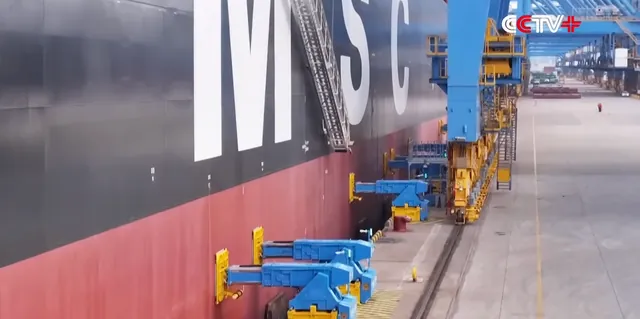
Kelly pointed out that China has spent a generation implementing a comprehensive national maritime strategy, and operates more than 5,500 vessels in international commerce. Chinese shipyards, he said, hold 62% of the global order book for merchant vessels, while American builders hold less than 1%. Furthermore, Kelly said, Chinese entities have invested hundreds of billions of dollars around the world in strategic ports and technologies deeply rooted in global commerce.
“Now, to be clear, I do not believe that the United States should want or seek conflict with China,” said Kelly, who has been mentioned as a possible presidential candidate in 2028, “and I do not think it’s inevitable. ” To that end the United States needs to be doing a lot more in the maritime domain. “As a nation, we need to develop a national maritime strategy,” Kelly said, to applause.
The Trump administration recently released its own Maritime Action Plan that Kelly said includes some of the same elements of the SHIPS act. S. ports, and on imports coming through ports of entry on land.
S. maritime sector is a long-term project that will require years of commitment and investment before meaningful results are realized. Said Kelly, “I use the word ‘maritime’ intentionally.
We can’t just be focused on shipyards, ports or ships or workforce. This can’t be seen just as a problem that can be solved by the Navy or the Coast Guard, or the Maritime Administration. ” Importantly, Kelly said the bill is fighting a timeworn sentiment in Washington that maritime is a zero-sum game.
“Congress does something to help shipyards, it hurts ports. If Congress does something to help ports, it hurts mariners. So people often think about this, and that’s simply not true.
I’ve been following the maritime industry since the 1980s, and these battles were happening back then. And what we have to show for it? Not much.
We have fewer ships and we have less competitive shipyards. Ports are no longer state of the art; some are falling apart, and every aspect of the industry is facing workforce challenges. “If the American maritime industry isn’t willing to unite around a comprehensive strategy to seriously compete on a global scale, then everybody in the industry will stop,” said Kelly.
“But here’s the good news: For the first time. In nearly 50 years, there is a bipartisan consensus here in Washington, right now, that we need to do more to strengthen the American maritime industry. And that means we have a chance.
” The 300-page SHIPS bill has had a Senate hearing and Kelly expects one soon in the House of Representatives. “I believe we have an opportunity to get something done this year,” said Kelly. “You have a bi-partisan, the majorities in Congress and the administration, all on the same page.
That doesn’t happen often, especially right now. ” Kelly joked that, “I’m a guy who used to have to climb into a rocket ship built by the lowest bidder. That forces you to be an optimist.
” Kelly encouraged ports and their stakeholders to review the legislation, and make suggestions to improve it. S. Trade Representative.
S. ports are globally competitive. None of us benefit If cargo destined for the United States is diverted to ports of Canada or Mexico.
I get that. Because the global maritime industry really needs a strong American presence on the high seas. The United States is the strongest military in the world, and the world’s largest economy.
” Kelly said that the maritime system underpinning global trade was developed by the United States, but is threatened by China’s dominant power at sea. “In any industry, the Chinese target predominance,” said Kelly. “Their strategy is to make the entire global industry dependent on Chinese state control, and they’ll engage in unfair market practices.
They’ll do whatever it takes to make that happen. I don’t think any of us want to see that happen to the maritime industry. S.
” Passage of the SHIPS act is a “win-win,” Kelly said. “We’ll address a critical vulnerability for our national defense, and counter Chinese influence in the global economy. And, we’ll do all of that while reinvesting in our economy, by bringing more jobs and more manufacturing back to the United States.
“America has always been a maritime nation. And working together, I know that we can reclaim our maritime heritage. ” Read more articles by Stuart Chirls here .