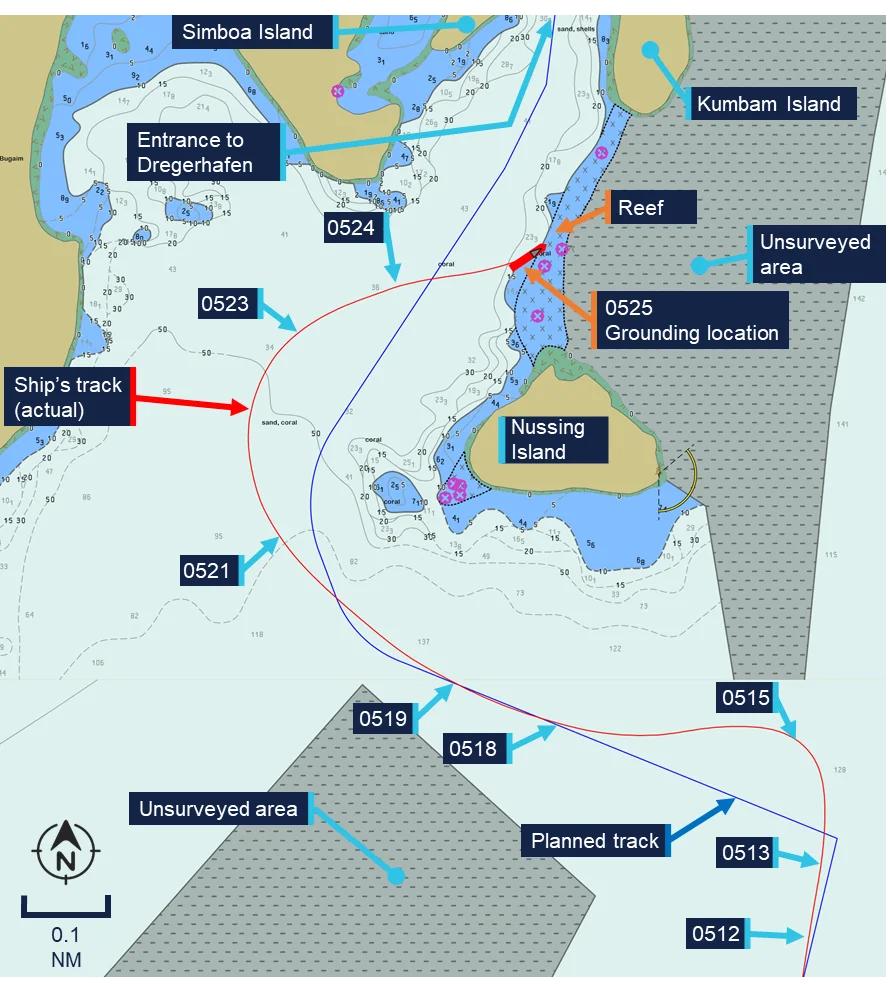
A preliminary report from the Australian Transport Safety Bureau (ATSB) has shed light on the events leading up to the grounding of the Coral Adventurer cruise ship near a remote port on the north-east coast of Papua New Guinea. The investigation reveals that the ship was traveling at a speed of 8 knots when it failed to execute a planned turn, resulting in a grounding on a reef. The incident occurred on December 27, 2025, with 80 passengers and 44 crew members on board. The ship's route had been altered during an overnight passage from Lababia to Dregerhafen, which involved navigating through a narrow channel with limited visibility.
The chief mate had made a small change to the planned route in the ship's Electronic Chart Display and Information System (ECDIS) to smooth out the second turn. However, when attempting to select this modified route, the ECDIS would not load until a 'route safety check' was performed via the route editor function. The chief mate then addressed this issue while the ship continued on its course, resulting in a missed waypoint and subsequent grounding.
The investigation has revealed that the ship's speed slowed considerably during a hard manual turn, from 3.8 knots to around 8 knots. In an attempt to regain the planned track, the chief mate increased the RPM setting of both Azipull thrusters, but this ultimately led to a wider-than-planned turn. The ship then continued past its planned track and grounded on a reef approximately 160 meters east of it.
The ATSB Chief Commissioner Angus Mitchell noted that the chief mate reported being unable to visually identify the surrounding topography in relation to what was being shown on the ECDIS, highlighting the importance of effective navigation procedures. The investigation will also review human factors considerations and analyze data captured by the ship's voyage data recorder.
The incident has raised questions about the effectiveness of passage planning and navigation procedures, particularly in remote areas with limited visibility. It is essential that operators take steps to mitigate these risks and ensure that their crew is adequately trained to navigate complex routes.
The Coral Adventurer's grounding serves as a reminder of the importance of effective communication and resource management during critical situations. The investigation will also examine the ship's emergency response procedures and overall safety oversight to identify areas for improvement.
As the investigation progresses, it is clear that the incident was the result of a combination of factors, including inadequate navigation procedures and human error. It is essential that operators learn from this incident and implement measures to prevent similar incidents in the future.
The ATSB's preliminary report provides valuable insights into the events leading up to the grounding of the Coral Adventurer. The investigation will continue to examine the data captured by the ship's voyage data recorder, as well as available CCTV footage, to determine the root causes of the incident and identify areas for improvement.
The incident highlights the importance of effective navigation procedures, particularly in remote areas with limited visibility. Operators must prioritize the safety of their crew and passengers, and take steps to mitigate risks associated with complex routes.
The incident highlights the importance of effective navigation procedures, particularly in remote areas with limited visibility.