


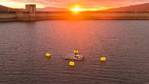
The pilot installation marks an important milestone for Fred. Olsen 1848's Tension Buoy technology, which is designed to ensure stability and performance for floating solar power systems under large water level variations. The adaptive mooring system can be tailored to any site, enabling reliable operation in reservoirs and dams with virtually no limits on water-level range or bathymetry.
The EDP Floating PV Lab, located in a Portuguese dam lake, provides an ideal testing ground for the Tension Buoy system due to its unique water level fluctuations of up to 50 meters. This natural variability allows for comprehensive validation of the technology's performance under extreme conditions. As a result, Fred. Olsen 1848 has been able to uncover key insights into the potential of hybrid renewable systems.
Tension Buoy's self-adjusting tensioning system is a significant departure from conventional solutions, which often struggle to adapt to changing water levels and bathymetry. The company's technology has the potential to revolutionize the way floating solar power systems are designed and operated, enabling them to harness energy in a wider range of environments.
The pilot installation was completed in just five days, demonstrating the efficiency and simplicity of the Tension Buoy deployment process. This streamlined approach is likely to be attractive to developers and operators looking to bring hybrid renewable systems online quickly and cost-effectively.
Fred. Olsen 1848's collaboration with EDP, Sperra, and local partners was instrumental in delivering the project on time and within budget. The involvement of multiple stakeholders has helped to accelerate the development of this innovative technology.
Sperra's 3D-printed gravity anchor played a crucial role in validating novel anchoring technologies under the site's extreme year-round conditions. This pioneering work has significant implications for the future of floating solar power systems, which are likely to become increasingly important as the world shifts towards renewable energy sources.
The pilot installation will continue to operate as a live demonstration for a year, providing valuable insights into the performance and reliability of Tension Buoy technology in real-world conditions. This ongoing testing is essential for ensuring that hybrid renewable systems can meet the demands of a rapidly changing energy landscape.
As the world continues to grapple with the challenges of climate change and energy security, innovative technologies like Tension Buoy are likely to play a critical role in shaping the future of renewable energy. By unlocking the potential of floating solar power systems, Fred. Olsen 1848 is helping to create a more sustainable and resilient energy mix.
The completion of this pilot installation marks an important step forward for Fred. Olsen 1848 and its partners, who are now poised to bring Tension Buoy technology to market and start harnessing the full potential of hybrid renewable systems.
This innovative technology has the potential to enable hybrid renewable systems to operate in a wider range of environments, leading to increased efficiency and reliability.


