

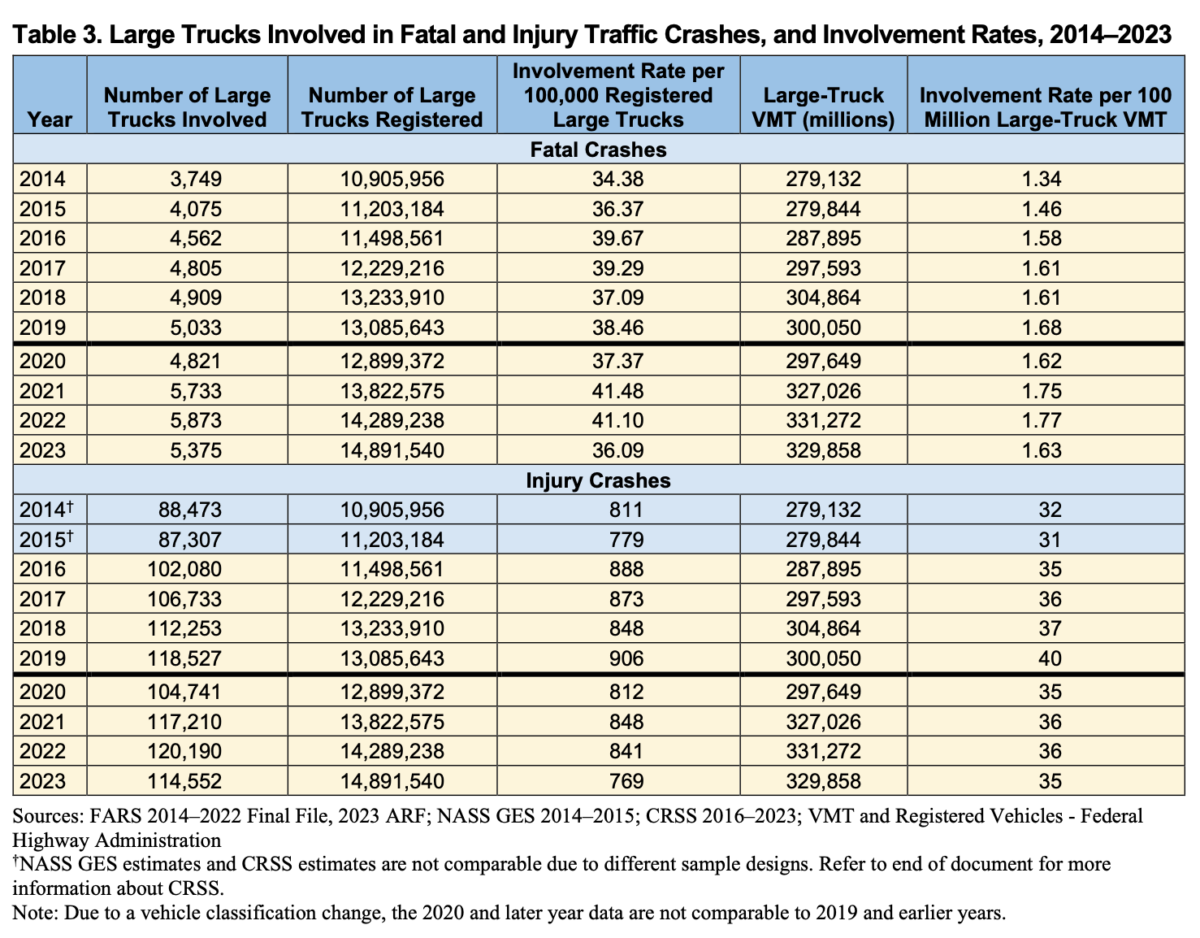
The National Highway Traffic Safety Administration (NHTSA) released its large trucks fact sheet for 2023, revealing a stark reality about fatal truck crashes. The report shows that despite the decrease in overall fatalities, the number of people killed in large truck crashes remains alarmingly high at 5,472. This figure is still one of the most serious highway safety challenges in the country.
The data also paints a more accurate picture than often portrayed on social media, where immigration status and citizenship are frequently cited as contributing factors to truck crashes. However, the NHTSA fact sheet makes no mention of these topics, instead focusing on the driving records of those involved in fatal crashes.
A closer look at the data reveals that large truck drivers were more likely than other vehicle types to have a prior crash on their record, with 19.4% of all fatal crashes involving commercial trucks having previously recorded traffic crashes. This is significantly higher than passenger car drivers, who had 14.1%, and light truck drivers, who had 15.3%.

Moreover, large truck drivers were more likely to have meaningful speeding convictions, with 17.3% of all fatal crashes involving commercial trucks having prior speeding convictions. This rate is also higher than passenger car drivers, who had 22.4%, but lower than motorcyclists, who had 25.1%.
In contrast, large truck drivers were less likely to have had a license suspended or revoked, with only 6.4% of all fatal crashes involving commercial trucks having prior license suspensions or revocations. This rate is significantly lower than passenger car drivers, who had 12.2%, and light truck drivers, who had 9.8%.
The combination of data points suggests that the commercial drivers involved in fatal crashes were more likely to have a prior crash on their record, meaningful speeding convictions, but less likely to have had a license suspended or revoked. This raises questions about the effectiveness of safety systems in identifying and addressing these risks.
According to the FMCSA's Large Truck Crash Causation Study, driver action or inaction was the critical reason in 88% of crashes involving large trucks. This highlights the need for a more nuanced understanding of truck safety, one that prioritizes driver behavior and accountability.
The study also found that driver behavior was the primary factor in most fatal crashes, rather than weather conditions, road conditions, or vehicle failure. This suggests that driver training and education programs may be more effective in preventing crashes than previously thought.
Ultimately, the data from the NHTSA fact sheet and the FMCSA's Large Truck Crash Causation Study paint a complex picture of truck safety. By prioritizing driver behavior and accountability, we can work towards reducing the number of fatal crashes on our roads.
The data highlights the need for a more nuanced understanding of truck safety, one that prioritizes driver behavior and accountability.