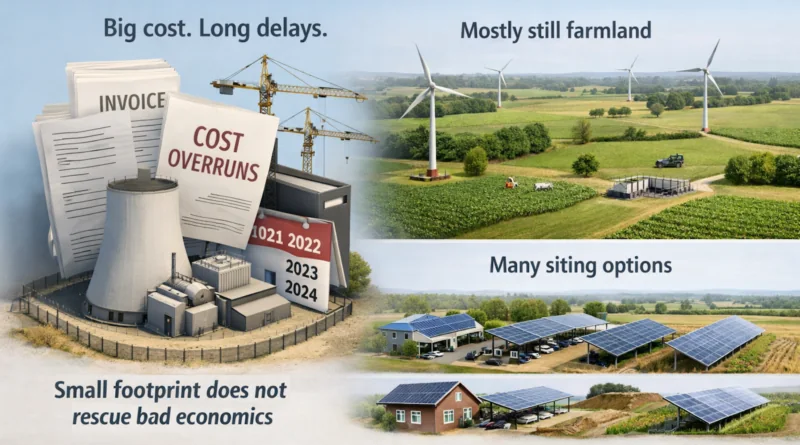
The claim that nuclear power uses less land than renewables is making the rounds again, usually presented as if it settles a complex debate with one clean visual. A nuclear plant fits inside a compact fenced site. Wind turbines are spread across plains and ridgelines. Solar arrays cover visible surfaces. The eye sees density and jumps to efficiency.
This misleading narrative has been circulating on LinkedIn posts, where nuclear advocates were presenting compact footprint as if it were a serious strike against wind and solar. A closer examination reveals that this is an old and long debunked talking point getting a fresh round of circulation.
Search interest around phrases like “nuclear land use” and “nuclear footprint” have risen in 2025 and 2026, with the World Nuclear Association resurfacing the claim in late 2025 through a biodiversity frame. Meanwhile, the Nuclear Energy Institute had been making the same comparison years earlier.
The nuclear land use canard is not only misleading but also ignores the significant costs associated with land acquisition, permitting, and infrastructure development for nuclear power plants. These costs are already factored into the delivered price of electricity.
In reality, wind and solar projects often require larger land areas to accommodate their physical footprint, including transmission lines and substations. However, these costs are typically spread across multiple years, making them less burdensome than the upfront capital costs of nuclear power.
Furthermore, the argument relies on a flawed comparison between the physical footprint of different energy technologies. It fails to account for the complexity of siting practices and decarbonization timelines, which can significantly impact the overall cost-effectiveness of each technology.
The math is not hard: a utility solar project may need 2 to 3 hectares per MW depending on terrain, layout, and tracking. This translates to significant land costs, but these are still dwarfed by the financing risks and construction delays associated with nuclear power.
In conclusion, the nuclear land use canard is a flawed argument that ignores the complexities of energy technology development and deployment. It is essential to consider the full range of costs and factors involved in evaluating the relative merits of different energy sources.
Ultimately, the debate over the most effective way to reduce greenhouse gas emissions should be grounded in evidence-based analysis rather than simplistic comparisons between physical footprints or land use efficiency.
The nuclear land use canard relies on a flawed comparison between the physical footprint of different energy technologies.