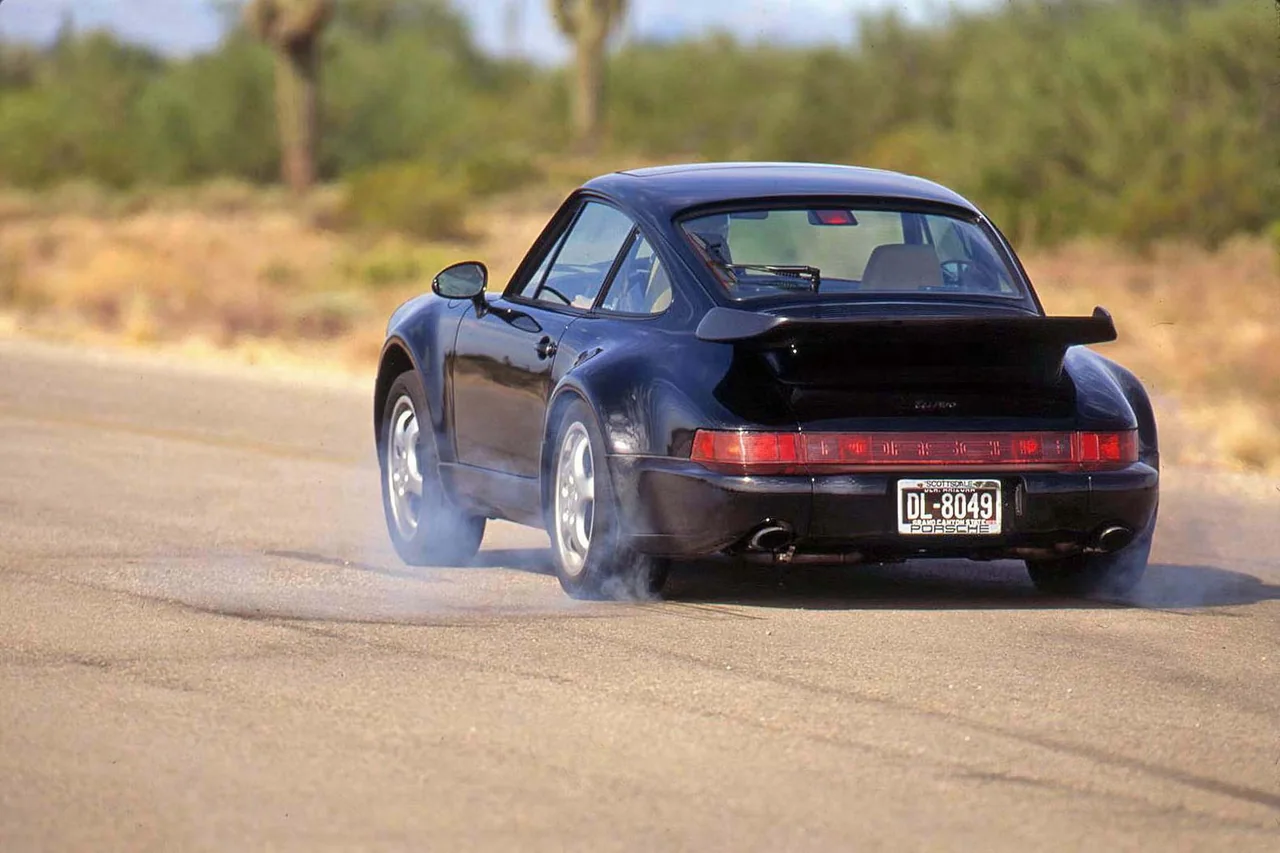
Porsche has released an exclusive new model, the 911 Turbo S2, which is a sportier variation of the already rapid and powerful Turbo model. The model was created as the streetable counterpart to the 911 Turbos being raced in the IMSA Supercar Series. The S2's extra sport comes from a larger, more efficient intercooler, a new KKK turbocharger that breathes easier at high rpm, and slightly hotter cams that match the revised turbo's high-revving orientation.
The modified engine develops 322 hp at 6200 rpm and a torque peak of 354 pound-feet at 4800 rpm. 7 seconds. However, the extra power added to the top end has come from the bottom, making the S2 a slug around town.
The engine doesn't get fired up until the tach needle wings past 4000 rpm. Despite this, the S2 feels just like a stock Turbo, which is not surprising because nothing else was changed on the car. It's a testament to the chassis that it copes so effortlessly with the additional 50-odd hp.

The brakes are huge and vented, with ABS-assisted four-piston calipers, and the tires are wide and grippy. The S2 retains the compact, upright layout of every 911, making it one of the world's most livable supercars. Porsche is planning to build only twenty S2s, which can be obtained by specifying the TS2 option package on a 911 Turbo.
A revised 911 Turbo is also coming soon, but its engine output suggests that it will be slightly sower at the top end than the S2.
The 1993 Porsche 911 Turbo S2 is an exceptional example of a limited-production model that caters to drivers seeking high-performance capabilities. Its impressive acceleration and top speed make it one of the meanest Porsches available, but its sluggishness in low-speed driving is a notable trade-off.