

The biggest car news and reviews, no BS. Our free daily newsletter sends the stories that really matter directly to you, every weekday. Adding electronic fuel injection and turbochargers can really boost both the performance and efficiency of an older engine.
But how well do those modifications work when they’re applied not to a muscle car’s small block V8, but to the massive engine that powers a British Centurion tank? 0-liter V12 adapted from the Merlin aero engine that powered the legendary Supermarine Spitfire and North American P-51 Mustang fighter planes in World War II. It lacked the Merlin’s supercharger, but still made 610 horsepower in the Centurion, which was Britain’s mainstay tank of the early Cold War.
Finished too late for World War II, it served in the Korean War and various other conflicts. The 1940s engineering makes it hard to keep a Centurion running in the 2020s. Its magnetos and carburetors hinder reliability, and even by tank standards, it’s not what you’d call fuel efficient.

Twin turbos are expected to boost output to over 1,000 hp which, judging from past experimentation, should be easily achievable with this engine. The transmission wasn’t designed to take that much power, however, and there aren’t exactly aftermarket upgrades available. The plan is to retain as much original hardware as possible.
A new intake manifold will be linked to the existing air intake and mechanical throttle linkage, and the turbos will be plumbed into the stock exhaust manifolds. Removing fuel tanks that normally sit astride the engine (and are no longer needed since this tank won’t be seeing anymore battlefields) makes room for them. The Meteor also has two intake valves per cylinder, so it will get two injectors per cylinder as well, for a total of 24.
The new intake manifold will need to accommodate those, as well as two throttle bodies and the fuel rails. Designing and fabricating the manifold, with help from a 3D scan of the engine, will be the first step in the process of upgrading this old warrior. Installing the new hardware is one thing, but getting it working properly is another.
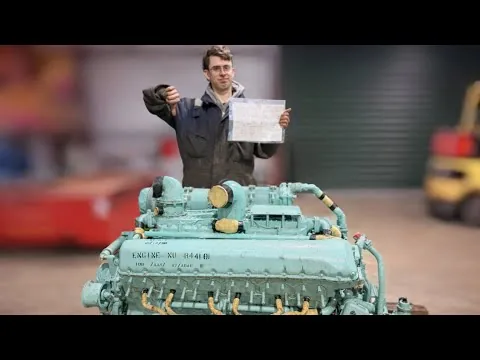
Unlike Meteor-powered hot rod builds, you can’t strap a Centurion to a dyno to tune it. I’m excited to see how Scott Nagle tackles this challenge and brings this historic engine into the modern era.
This project showcases the ingenuity of modern engine modification techniques applied to a unique historical context. The potential for significant performance gains through EFI and turbocharging is substantial, but it will be interesting to see how the complexities of the Centurion's original design are addressed in the process.