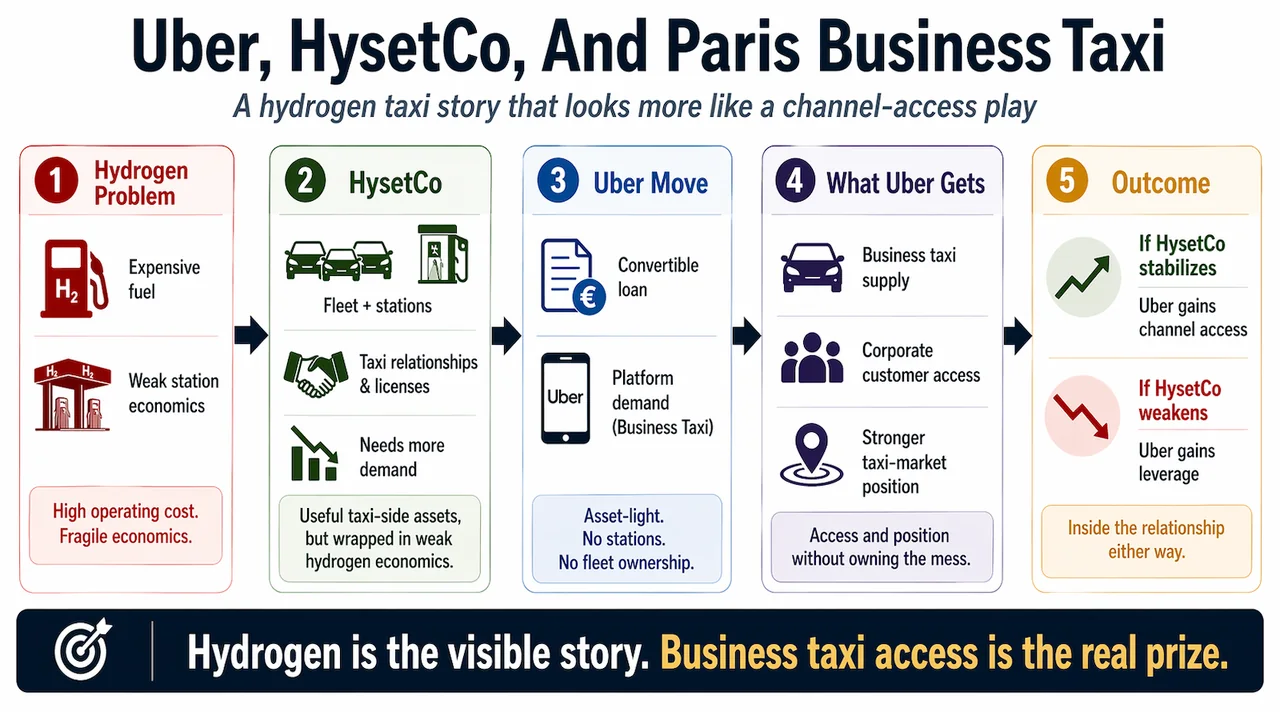
Uber's investment in HysetCo highlights the company's efforts to offer cleaner zero-emission business travel options in Paris.
The addition of nearly 2,000 hydrogen taxis to Uber's platform over five years is seen as a major step forward for the company's sustainability goals. However, given the high fuel costs and weak station economics of hydrogen vehicles, it remains unclear why Uber is investing heavily in this technology.
The vehicles leased through HysetCo are primarily Toyota Mirais, which are competent sedans but lack the premium features that would justify their use as business cars. The press releases surrounding this investment claim a cleaner zero-emission option for corporate customers, but this may be more of a marketing gimmick than a genuine innovation.
The energy cost per 100 kilometers for a Mirai is three to five times above a battery electric car fast charging in France, making hydrogen fuel a less attractive option. This is particularly concerning given the recent collapse of the homeopathic sales of hydrogen cars globally.
HysetCo's withdrawal from light hydrogen mobility in Paris serves as a clear signal that the underlying economics were weak and not improving. The company had been paying €16-€18 per kilogram for hydrogen before VAT, but now pays €19.20-€21.60 per kilogram at the pump.
The investment by Uber through a convertible loan allows HysetCo to receive immediate funding, while Uber retains the option to convert it into equity later. This structure raises questions about the level of control and ownership that Uber will have over HysetCo's operations.
Despite the official rhetoric surrounding innovation, reliability, and cleaner mobility, the numbers remain ugly for hydrogen vehicles. The product is underwhelming, and the infrastructure still looks more like a capital-intensive support system than a healthy retail fuel business.
The Mirai-centered fleet is not an executive transport breakthrough but rather a workaround to offer a zero-emission option. The vehicle's lack of roominess and premium features makes it less appealing as a business car.
HysetCo's broader hydrogen fleet includes vans and light commercial vehicles, which may be useful in certain niches. However, this does not address the fundamental issue of hydrogen fuel being too expensive relative to electricity.
The high operating costs of hydrogen vehicles make them uncompetitive unless someone else is absorbing the pain. This highlights the need for a more comprehensive solution to the challenges facing hydrogen mobility.
Investment may be a strategic move to expand business taxi services, but underlying economics remain uncertain.