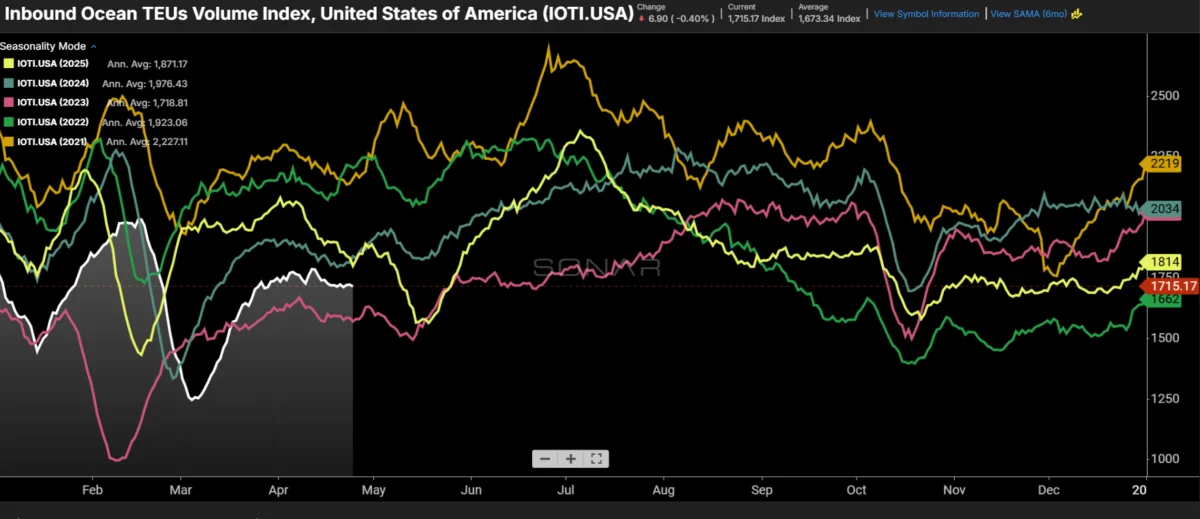
The recent domestic freight market upheaval has been largely driven by factors other than import demand, which has been a relatively non-factor in this cycle. However, it's essential to examine how import demand has influenced surface transportation markets in recent years and consider its potential impact on the rest of 2026.
The Inbound Ocean TEUS Volume Index (IOTI) is a 14-day moving average that measures the volume of requests to move twenty-foot containers to the U.S. via ocean, hitting an all-time peak of 2,692 in June 2021.
Despite its current value being well below that figure, the IOTI does not necessarily indicate unhealthy demand. Shippers have been concerned about service disruptions and tariffs, leading them to order ahead of expected fulfillment in a just-in-case ordering strategy.
In 2024 and 2025, shippers began to restock as conflict in the Middle East threatened maritime capacity and service, driving erratic ordering and inventory growth.
As tariff concerns settled in late 2025, orders fell back into a more traditional pattern, aligning almost perfectly with inventory levels — a leaner model that closely resembles just-in-time practices.
Leaner warehouses associated with just-in-time practices keep inventory costs low but are less capable of absorbing demand shocks and require more consistent transportation service.

This shift towards leaner warehouses is happening as the trucking market emerges from one of its softest and longest downturns in years, leaving it ill-equipped to flex in response to any upswing in demand.
The SONAR Truckload Volume Index measures electronic requests from shippers to carriers for truckload capacity, which has reached its current level several times over the past few years but with rejection rates far lower then.
The lack of import demand has allowed the trucking market to tighten without assistance, leaving it vulnerable to disruptions in the supply chain.

The lack of import demand has allowed the trucking market to tighten without assistance, leaving it ill-equipped to flex in response to any upswing in demand.