
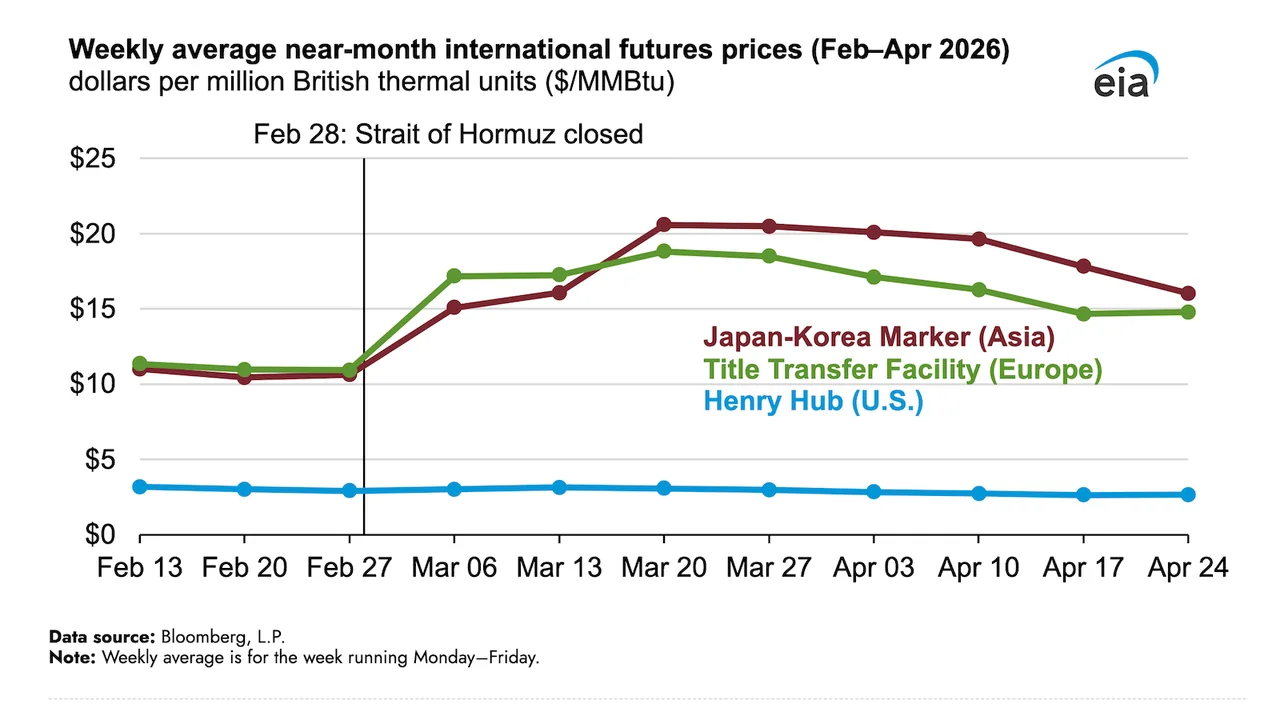
The closure of the Strait of Hormuz on February 28 has had a profound impact on the global LNG market, with prices diverging significantly across different regions. In Europe and Asia, futures prices for liquified natural gas have increased substantially since the closure, while in the United States, prices have decreased due to limited opportunities for increasing LNG exports.
The closure of the strait has affected over 10 billion cubic feet per day (Bcf/d) of global LNG supplies, or approximately 20% , mostly from Qatar's Ras Laffan export facility. This reduction in supply has led to a significant increase in prices, with the front-month futures price for the benchmark Japan-Korea Marker (JKM) rising 51% over the same period.
The impact of the closure on LNG supplies is expected to be felt across various regions, including Europe and Asia, where natural gas storage inventories are already at record lows. European natural gas storage inventories finished the winter season at 28% full, below the five-year average of 41%, according to Gas Infrastructure Europe.
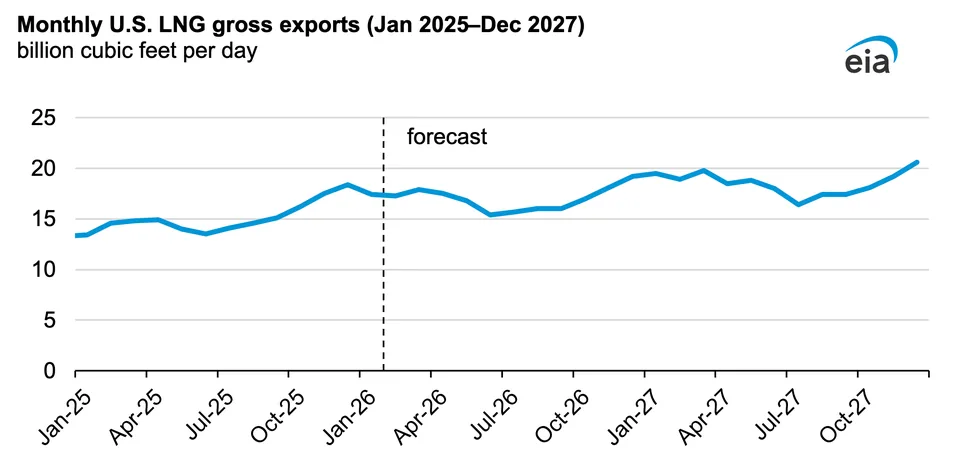
In contrast, the United States has seen a decrease in LNG prices due to limited opportunities for increasing exports in the near term and ample domestic seasonal natural gas storage and supply. However, this decrease is expected to be short-lived, as US LNG exports are expected to increase, albeit with limited growth.
The US Department of Energy has approved two increases to terminal export authorizations to countries lacking free trade agreements (FTAs) with the United States since February— Plaquemines LNG and Elba Island. These approvals are expected to contribute to an increase in US LNG exports, but will likely be offset by limited growth due to existing high utilization rates at US LNG terminals.
Operators already run US LNG terminals at high utilization rates, limiting additional natural gas export growth. This, in turn, limits the potential for significant price increases in the US domestic market. The United States exported an estimated 17.9 Bcf/d of LNG in March, the second-highest monthly export volume since December 2025's record 18.4 Bcf/d.
The closure of the Strait of Hormuz has also had a significant impact on Asian buyers, who are competing for spot cargoes to replace lost contract volumes. QatarEnergy declared force majeure on March 4, which has forced these buyers to seek alternative supplies.
As the global energy market continues to navigate the challenges posed by the Strait of Hormuz closure, it is clear that the implications will be far-reaching and multifaceted. The increased prices and reduced supply will likely have a significant impact on energy markets across various regions, driving up costs for consumers and businesses alike.
The Strait of Hormuz closure has significant implications for the global energy market, as it limits the supply of liquefied natural gas (LNG) and drives up prices.