
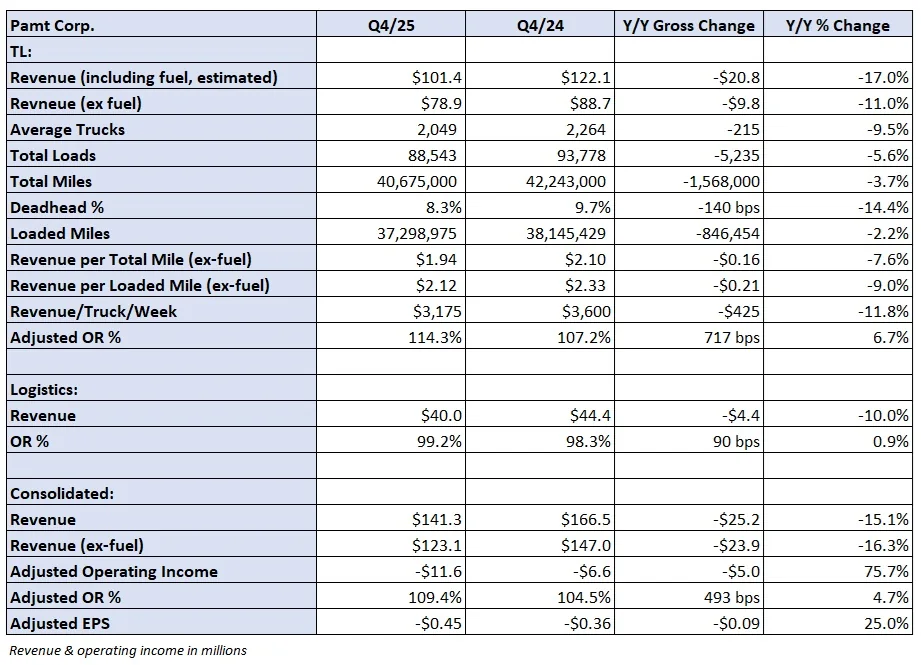
Pamt Corp., an Arkansas-based truckload carrier, reported a net loss for the fourth quarter before the market closed on Friday. The company's fifth consecutive quarterly loss was marked by a significant headline loss of $29.3 million, or $1.40 per share. This result included a $26.5 million adjustment to its auto liability reserve associated with a specific claim expected to settle in excess of insurance policy limits.
The adjusted loss for the quarter, excluding this charge, was $9.4 million, or 45 cents per share. In comparison to the previous year's fourth quarter, this represents a decrease of 9 cents per share. The decline can be attributed to various factors, including higher interest expense and lower revenue from the automobile industry.
On a year-over-year basis, Pamt's consolidated revenue fell 15% to $141 million. This represents a significant decline in revenue, largely due to the pressure on the automobile industry caused by tariffs. As a result, roughly one-third of the company's revenue comes from this sector, which continues to face challenges.

The truckload unit saw a 10% year-over-year decline in average trucks in service, with revenue per truck per week dropping 12%. Loaded miles also decreased by 2%, while revenue per loaded mile fell by 9% to $2.12, excluding fuel. These declines indicate a significant downturn in the company's core business.
The segment reported an adjusted operating ratio of approximately 114%, excluding the insurance charge. This represents a 700 basis point decline compared to the previous year. The operating margin was also severely impacted by this charge, leading to a wider-than-expected loss for the quarter.
Salaries, wages, and benefits expenses as a percentage of revenue increased by 240 basis points year-over-year, despite a reduction in company drivers. Depreciation expenses also rose by 200 basis points, excluding a prior-year item. These expense increases highlight the challenges faced by Pamt's truckload unit.

This was the ninth consecutive operating loss for the truckload segment, underscoring the difficulties faced by the industry as a whole. The decline in revenue and profitability is likely to have significant implications for Pamt's ability to invest in its business and respond to changing market conditions.
Logistics revenue declined 10% year-over-year to $40 million, while operating metrics like load counts and revenue per load are not provided by the company. This lack of transparency makes it difficult to assess the full extent of the decline in Pamt's logistics segment.
Pamt generated operating cash flow of $17 million in 2025 and had liquidity of $144 million, which was $31 million lower than in the third quarter. However, outstanding debt of $334 million remained relatively stable sequentially, indicating some stability in the company's financing situation.