Diesel prices have seen a slight decrease this week, with the benchmark price used for most fuel surcharges falling by 0.1 cents/gallon to $5.639/g, effective Monday and published Tuesday. This decline comes after a sharp increase of 28.9 cts/g last week, which followed three weeks of declines.
The small downward move is attributed to a schism in oil market views about where they might be headed, with some analysts predicting a significant decrease in supply and others expecting a surge in prices.
However, the relative calm in recent weeks has led to confidence that oil markets have taken a big loss in supply stride and managed to rise sharply but not move into areas seen only at two other times in history: the 2008 price surge and the 2023 reaction to Russia’s invasion of Ukraine.

The energy economist Philip Verleger stated, “Based on historical data, crude should now trade for around $200 per barrel.” However, the futures price of Brent is currently trading below this level, with recent upward moves seen in the past two days.
The increase in Brent's price has been followed by further gains, with the futures price settling at $107.41/barrel on Tuesday, a gain of $3.20/b from Monday’s settlement.
Meanwhile, ultra low sulfur diesel (ULSD) on CME has also seen an upward trend, with prices up 9.43 cts/g from Monday to $4.0692/g.

The worldwide squeeze on inventories that is becoming a focus of oil markets is highly visible in recent weekly statistics from the Energy Information Administration (EIA).
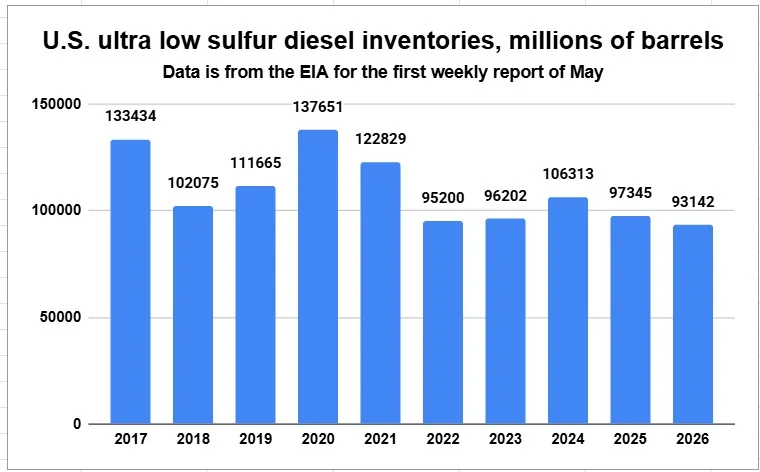
Nationwide stocks in the U.S. of ULSD for the week ended May 1, reported Wednesday, were at 93.14 million barrels, a decline of 14.8 million barrels since the Iran war began in March.
The report shows ULSD inventories below every other year in that 10-year stretch, indicating a tightening of the diesel market relative to crude.
The recent increase in diesel prices may be short-lived as market fundamentals start to tighten.