HVS's failure highlights the challenges of scaling up hydrogen fuel cell technology for heavy-duty freight.
Despite significant investment, many hydrogen transportation projects struggle to achieve commercial viability.
Hydrogen transportation has produced a long stream of announcements across various industries, but few have resulted in successful deployments.
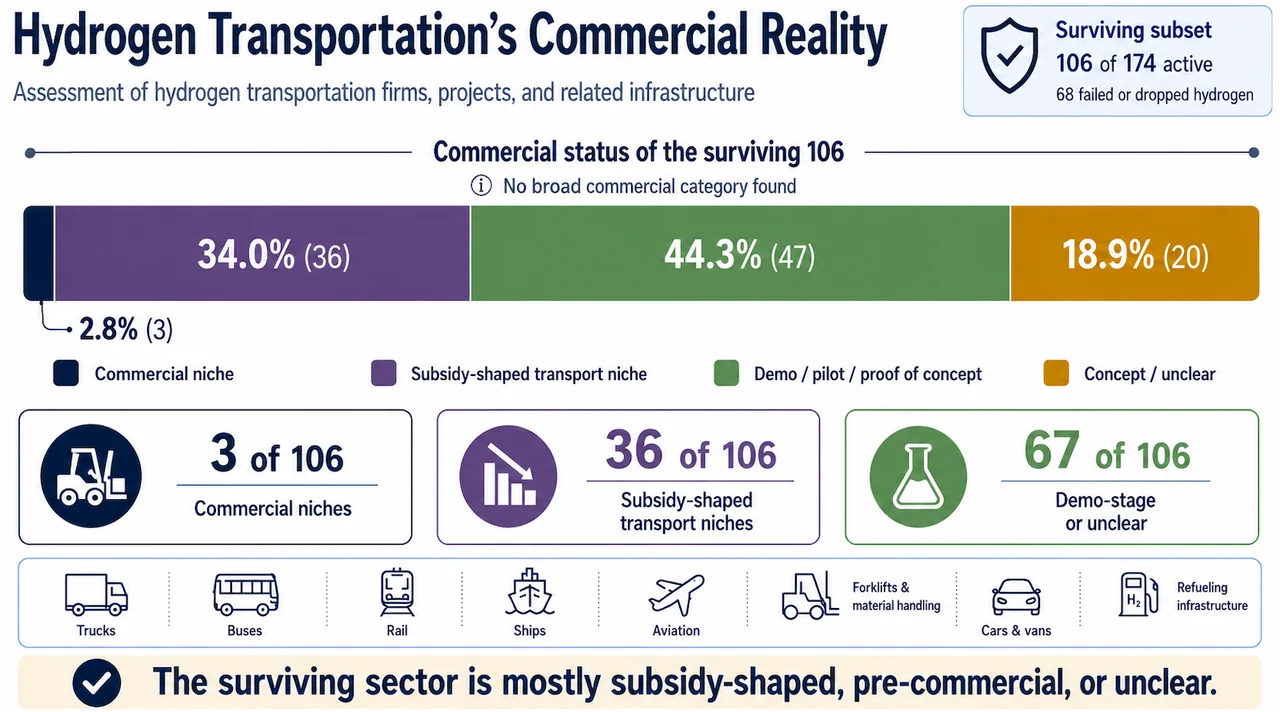
The dataset contains 174 firms and projects promoting hydrogen for transportation or related mobility infrastructure.
Many hydrogen transportation initiatives are still active, but the majority have failed or dropped the idea.
The remaining 106 active projects can be categorized into four categories: commercial niches, subsidy-shaped transport niches, demo, pilot, or proof-of-concept activity, and concept or unclear status.
Commercial niches refer to industries with repeat customers for hydrogen transportation use cases.
Subsidy-shaped transport niches involve government support for specific transportation modes.
Hydrogen fuel cell technology remains a promising solution for reducing emissions in the transportation sector.
However, addressing regulatory hurdles and scaling up production remain significant challenges for widespread adoption.
The future of hydrogen transportation will depend on overcoming these challenges and finding ways to make the technology more efficient and cost-effective.
The business case for hydrogen transportation did not close around engineering, but rather around scaling up production and addressing regulatory hurdles.