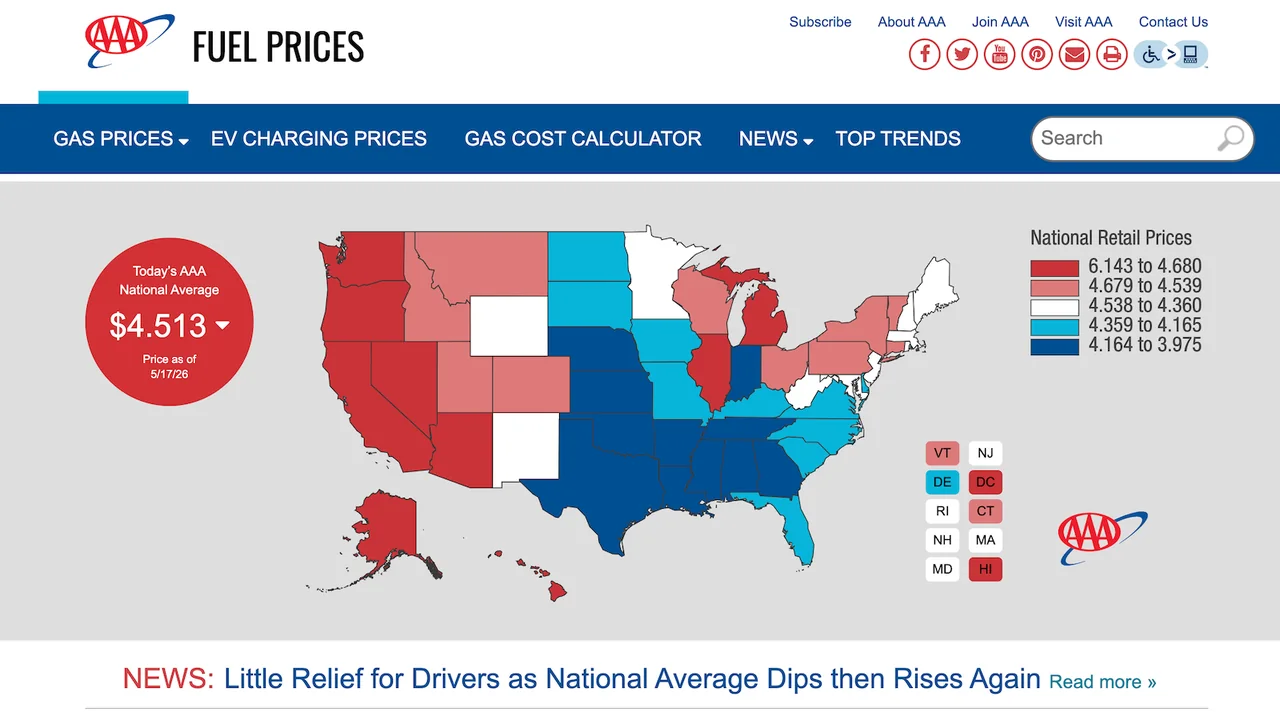
The United States has witnessed a significant surge in gas prices over the past few months, with the average price now standing at $4.517/gallon. This represents a staggering 56% increase since late February, when the country's involvement in Iran led to an escalation of tensions in the Middle East. The rapid rise in gas prices is having a profound impact on budget-strapped households, who are already feeling the pinch from rising costs of living. As the situation continues to unfold, it remains unclear what measures will be taken to mitigate the effects of this crisis.
The ongoing conflict in Iran and the Strait of Hormuz blockade have been major contributors to the surge in gas prices. Despite various reports suggesting potential solutions to the crisis, no concrete steps have been taken to address the issue. The New York Times recently reported that hopes for an end to the war in Iran had faded after President Trump failed to secure a commitment from China to help persuade Iran to reopen the Strait of Hormuz.
The situation is all too familiar, with gas prices having risen significantly over the past few months. In February, the average price stood at $2.89/gallon, but has since increased to $4.517/gallon. This represents a dramatic 56% increase, which is having a profound impact on households across the country.
The International Energy Agency has characterized the current supply disruption as the 'largest in the history of the global oil market'. With oil reserves dwindling, it remains to be seen how much longer the situation can continue before gas prices reach extreme levels. Unless a political solution is achieved soon, the consequences will be severe.
As the situation continues to unfold, it is clear that something needs to be done to address the crisis. The world has largely been relying on oil reserves to keep prices relatively low, but these are starting to run out. It is essential that a solution is found as soon as possible to mitigate the effects of this crisis.
In the meantime, many experts are advising households to take steps to reduce their energy consumption and explore alternative modes of transportation. With gas prices at an all-time high, it may be more cost-effective to consider purchasing an electric vehicle.
The current situation is a stark reminder of the fragility of the global oil market. As tensions in the Middle East continue to escalate, it remains unclear what the future holds for gas prices and the economy as a whole.
With oil reserves dwindling and no clear solution in sight, the consequences of inaction will be severe. It is essential that policymakers take immediate action to address the crisis and mitigate its effects on households across the country.
As the situation continues to unfold, it is clear that something needs to be done to address the crisis. With gas prices at an all-time high, it may be more cost-effective to consider alternative modes of transportation, such as electric vehicles.
The situation is dire, with oil reserves dwindling and no clear solution in sight.