

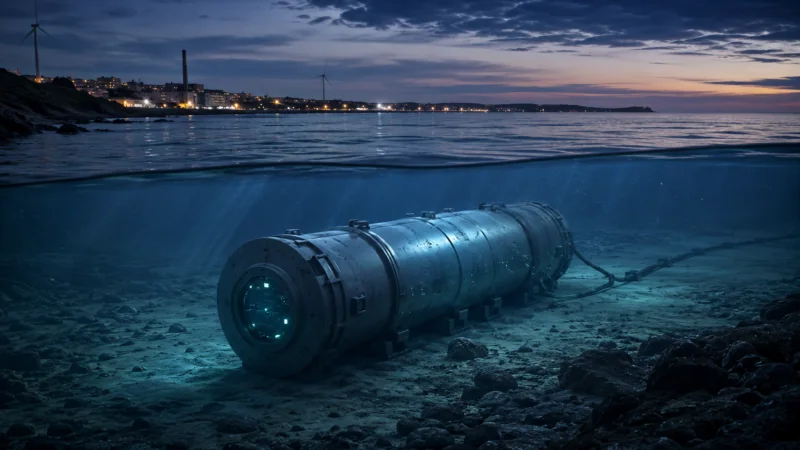
China has taken a significant step forward in the development of underwater data centers, with a commercial project now operational in the Lingang area. This marks an important milestone in the exploration of this innovative technology. Underwater data centers aim to reduce the environmental impact of traditional data centers by harnessing the natural cooling properties of seawater. By placing sealed data center modules beneath the ocean's surface, these facilities can significantly decrease their energy consumption and carbon footprint.
The concept of underwater data centers has been gaining attention in recent years, with several companies exploring its potential. Microsoft's Project Natick is a notable example of this trend, having successfully deployed an underwater data center pod off Scotland's Orkney Islands in 2018. The project demonstrated promising results, with the servers in the underwater pod experiencing a significantly lower failure rate compared to their land-based counterparts.
However, despite these positive outcomes, there are still significant engineering challenges associated with building and maintaining underwater data centers. These include issues related to serviceability, deployment logistics, subsea connections, permitting, environmental review, operating risk, and the need for specialized equipment.
The Shanghai underwater data center project is a significant step forward in addressing some of these challenges. With a target scale of 24 MW, this facility will be capable of supporting large-scale computing operations. The use of seawater cooling linked to offshore wind power further highlights the potential of this technology to reduce its environmental impact.
China's expertise in engineering and infrastructure development has been instrumental in bringing this technology to fruition. The country's ability to turn engineered concepts into steel, concrete, cables, substations, ports, vessels, and operating assets is a key factor in the success of these projects.
The development of underwater data centers also underscores the growing importance of addressing the cooling challenges faced by traditional data centers. As AI workloads continue to push more electricity through densely packed chips, reducing mechanical cooling loads becomes increasingly crucial.
Furthermore, hot, land-constrained coastal locations with strong marine engineering capabilities and nearby clean electricity sources are well-positioned to benefit from this technology. By leveraging the natural cooling properties of seawater, these facilities can reduce their energy consumption and carbon footprint, making them more sustainable and environmentally friendly.
The success of underwater data centers in China serves as a reminder that innovative technologies often require significant investment and expertise to develop and implement. As the demand for computing power continues to grow, it will be essential to explore new solutions like these to address the environmental impact of traditional data centers.
However, it is also important to note that underwater data centers are not a silver bullet solution to the challenges faced by the industry. Rather, they represent one part of a broader strategy to reduce the environmental footprint of computing operations.
The future of underwater data centers will likely be shaped by their ability to address real-world engineering challenges and provide tangible benefits in terms of energy efficiency, sustainability, and operational reliability.
Underwater data centers require significant investment and expertise.