Hyundai Motor and Boston Dynamics have successfully taught a robot to play football using artificial intelligence. The team employed a widely used technique called reinforcement learning, which allows the robot to learn through trial and error. This process doesn't happen with the physical Atlas robot as it would be too slow and risky.
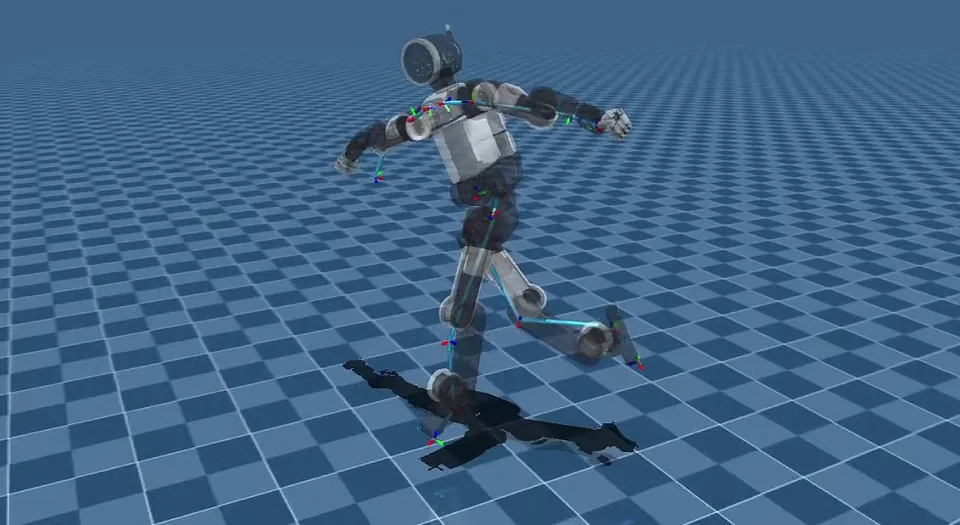
A more efficient approach was needed, so the team turned to a cloud-based simulated environment where the robot could repeatedly practice football movements at scale. Within this environment, the RL system rewards actions that successfully mimic human motion while maintaining balance and control. By doing so, the robot learns not just the motion itself but also the underlying physics of how to achieve it.
The virtual training is staggering in its scale. By running thousands of simulations in parallel on cloud GPUs, the team could condense the learning process exponentially. This massive, parallel learning allows the robot to rapidly master complex movements that would have been impossible to program by hand.
Over time, through countless attempts, the system learns not just the motion itself but also the precise motor controls, weight distribution, and forces needed to swing a leg, plant a foot, and stay upright. This level of detail is crucial for achieving balance and control on the football field.
The training process is a significant breakthrough in the integration of AI and robotics. By leveraging cloud-based simulations, Hyundai and Boston Dynamics have made it possible to teach complex tasks like playing football to robots in a relatively short period.
This technology has far-reaching implications for various industries, including sports, healthcare, and manufacturing. It could enable robots to perform tasks that were previously thought to be impossible or too challenging for human operators.

The use of reinforcement learning and cloud-based simulations has opened up new possibilities for the development of intelligent robots. As this technology continues to evolve, we can expect to see more advanced applications in the future.
The collaboration between Hyundai Motor and Boston Dynamics is a testament to the power of interdisciplinary research. By combining expertise from AI, robotics, and sports, they have achieved something truly remarkable.
This achievement serves as a reminder that even seemingly complex tasks like playing football can be broken down into manageable components using advanced technologies like AI and cloud-based simulations.
Looking ahead, it will be exciting to see how this technology is applied in real-world scenarios. Will we see robots competing in professional sports leagues? Can they assist humans in search and rescue missions? The possibilities are endless, and the future of robotics looks brighter than ever.
The integration of AI and robotics is revolutionizing the way we approach complex tasks.