


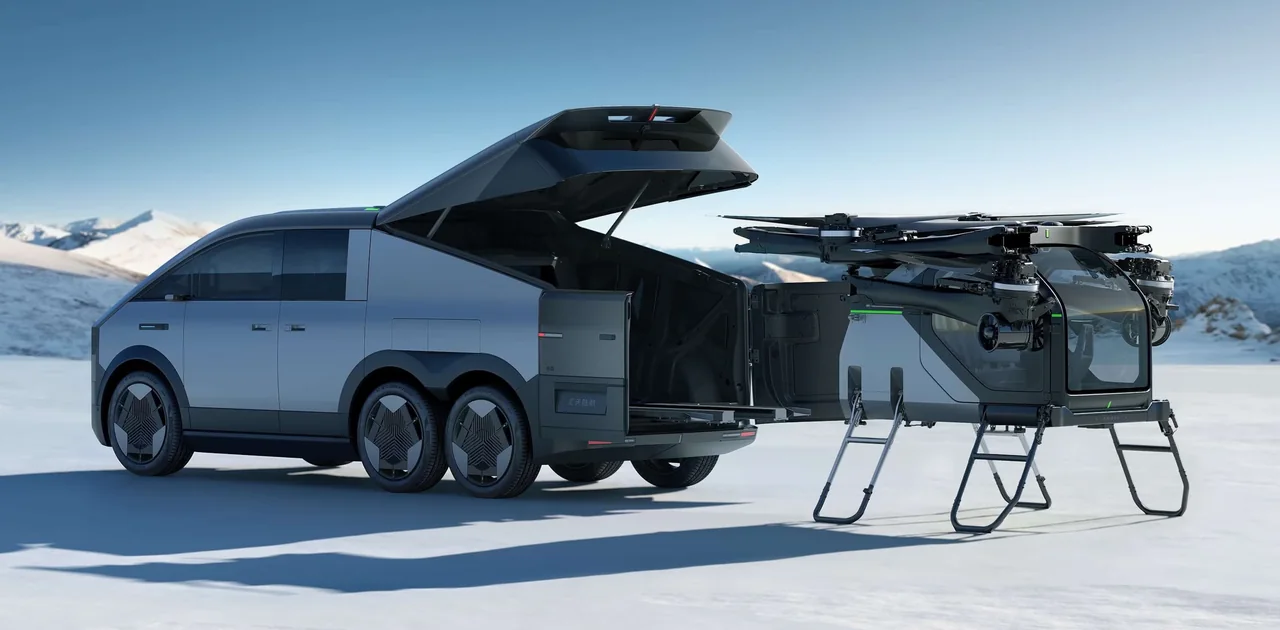
The worst traffic jam in history, which lasted 10 days and affected over 60 miles of cars, may soon be a thing of the past for those who own Xpeng's latest EV van. The vehicle is equipped with six driven wheels, a range-extended powertrain that provides 600 miles on a single charge, coach-style rear doors, and seating for four. Additionally, it features an aircraft that can deploy a six-rotor drone to ferry a human occupant off into the sky.
Xpeng's Land Aircraft Carrier is not just a concept, but a production-ready vehicle with plans to start mass production by late 2026. The company's European executives have confirmed that the factory is ready to build the vehicle, and pre-production models are already underway. This is a significant development in the field of mobility solutions.
The aircraft portion of the van is built by Xpeng's subsidiary Aridge, which features folding rotors and one-touch deploying action. There is also reportedly a tilt-rotor aircraft in development for longer-range flights. These innovative designs showcase the potential of drone technology in various applications.

While the idea of owning an EV van with a deployable personal aircraft may seem far-fetched, it highlights the growing importance of drone tech in mobility. Companies like Pivotal Aero are already selling electric-powered vertical takeoff and landing aircraft for personal use, demonstrating the potential of this technology.
However, regulatory issues do pose a challenge to the widespread adoption of such vehicles. It remains to be seen whether owners would need an actual pilot's license or just a drone operator's license to operate the aircraft portion of the van.
The Land Aircraft Carrier is more than just a novelty; it represents a significant step forward in the development of 2026 mobility solutions. The fact that Xpeng is taking this concept seriously and investing time and resources into its production is a testament to the company's commitment to innovation.

Despite being an export from China, the idea of owning such a vehicle may appeal to early adopters who are willing to navigate regulatory hurdles. For now, it remains to be seen how this technology will shape the future of transportation.
The potential applications of drone tech in mobility are vast and varied, and companies like Xpeng are at the forefront of exploring these possibilities. As the industry continues to evolve, it will be exciting to see how this technology is integrated into various vehicles and services.
While the Land Aircraft Carrier may not be available for purchase just yet, its development marks an important milestone in the history of automotive innovation. The fact that Xpeng has brought this concept to life demonstrates the company's dedication to pushing the boundaries of what is possible in the field of mobility.


