Cobots, or cooperative robots, are being increasingly used in the ship repair industry due to their ability to perform complex tasks with precision and accuracy. In a recent development, Nirav Patel, Nuclear Navy Segment Director at Fairbanks Morse Defense, has highlighted the benefits of cobots in welding applications. The company is responsible for maintaining a fleet of diesel engines that provide emergency backup power to onboard nuclear reactors, which pose a unique welding challenge due to their age and condition.
The traditional method of repairing these components required human welders to work in tight engine rooms with high-temperature welding arcs, resulting in grueling work that could take several weeks to complete. However, the introduction of cobots has reduced this time to just one week, thanks to their ability to perform precise welding tasks with minimal human intervention.
Cobots are designed to work alongside humans, rather than independently, which makes them a valuable addition to any workshop or production line. This collaborative approach also reduces the risk of accidents and hazards associated with high-speed robots, making them a safer option for workers.
The use of cobots in ship repair is not limited to welding applications alone. Chinese shipbuilder Xinneng Shipbuilding has introduced a robotic welding system for ship block production, with trials currently underway to collect data on its effectiveness.
Fincantieri has also launched a partnership with Generative Bionics to develop a humanoid welding robot that can work alongside human workers in shipyards. The first application of this technology is expected to focus on supporting selected naval welding tasks that incorporate AI and advanced manipulation capabilities.
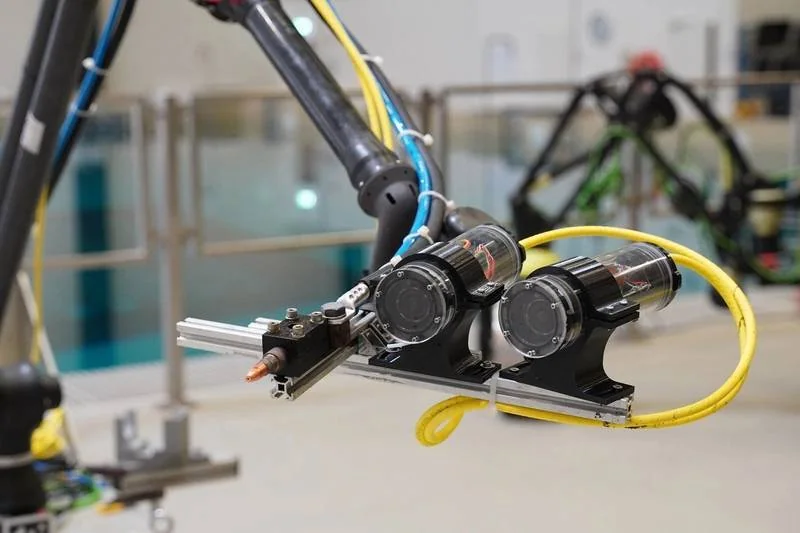
The MARIOW project, led by the German Research Center for Artificial Intelligence, has developed a robotic system capable of performing underwater welding tasks on port or offshore structures largely autonomously. This system uses a stereo camera system and AI models to determine where and how to weld, making it an important step towards increasing efficiency in the maritime sector.
One of the most significant advances made by the MARIOW project is its ability to use high-resolution imagery from a stereo camera system to identify weld joints and their start and end points. This technology has been demonstrated in DFKI's underwater test basin in Bremen, where it successfully completed automated underwater flux-cored arc welding.
The integration of cobots in the ship repair and building industry is expected to have significant impacts on labor costs and efficiency. As these technologies continue to evolve and improve, we can expect to see even more innovative applications in the years to come.
Overall, the use of cobots in the maritime sector is a promising development that could help to increase productivity and reduce costs. With their ability to perform complex tasks with precision and accuracy, it's clear that these robots are set to play an increasingly important role in the future of shipbuilding and repair.
The integration of cobots in ship repair and building processes is expected to significantly reduce labor costs and improve efficiency.