

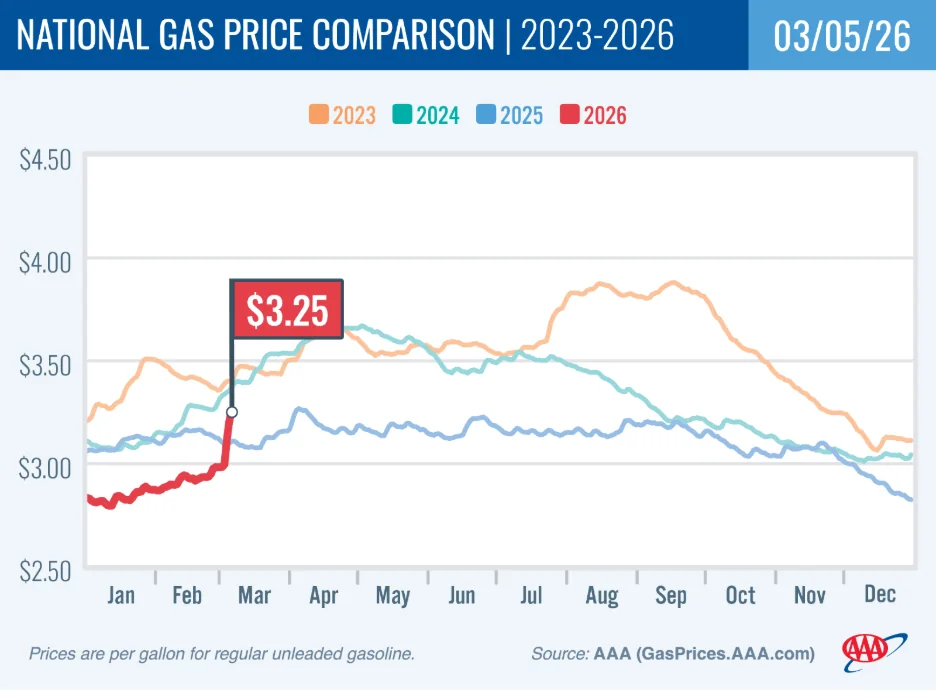
Gasoline prices have surged to nearly 27 cents higher than last week, with the national average now sitting at $3.25 per gallon. This sudden increase is largely attributed to the conflict in the Middle East, which has sent crude oil prices soaring to the mid-$70s per barrel range. As a result, consumers are feeling the pinch, and it's not just a matter of filling up their tanks; it's also affecting the broader economy.
The recent jump in gas prices is a stark reminder of the ongoing impact of global conflicts on energy markets. The conflict has disrupted oil production and distribution, leading to a sharp increase in prices. This, in turn, will have a ripple effect on various industries, including transportation, retail, and even consumer spending.
As springtime approaches, gasoline demand typically increases as people take to the roads for longer trips. However, with gas prices now at their highest level since early April 2025, it's likely that consumers will be more cautious about their fuel consumption. This could lead to a decrease in overall gasoline demand, which would further exacerbate the price surge.
The Energy Information Administration (EIA) reports that gasoline demand decreased last week from 8.73 million barrels per day to 8.29 million barrels per day. Meanwhile, total domestic gasoline supply decreased from 254.8 million barrels to 253.1 million barrels. Despite this, gasoline production increased last week, averaging 9.3 million barrels per day.
The recent price jump also led to a significant increase in crude oil inventories, which rose by 3.5 million barrels from the previous week. At 439.3 million barrels, U.S. crude oil inventories are about 3% below the five-year average for this time of year.
Despite the surge in gas prices, electric vehicle (EV) charging remains relatively affordable, with the national average per kilowatt hour staying the same at 39 cents. However, some states are taking a different approach, with Hawaii and Alaska leading the way in terms of public charging costs.
The nation's top 10 most expensive gasoline markets are California ($4.81), Washington ($4.44), Hawaii ($4.43), Oregon ($4.04), Nevada ($3.87), Alaska ($3.72), Arizona ($3.58), Illinois ($3.36), Pennsylvania ($3.35), and Michigan ($3.27). On the other hand, Oklahoma ($2.79) takes the top spot for the least expensive gasoline market.
The nation's most expensive states for public charging per kilowatt hour are West Virginia (52 cents), Hawaii (50 cents), Alaska (48 cents), Louisiana (47 cents), South Carolina (44 cents), New Hampshire (44 cents), New Jersey (43 cents), California (42 cents), Idaho (42 cents), and Tennessee (41 cents). Conversely, Kansas ($25 cents) leads the way in terms of affordable public charging.
The recent price surge is a stark reminder of the ongoing volatility in energy markets. As global conflicts continue to disrupt oil production and distribution, it's essential for policymakers and industry leaders to work together to find sustainable solutions that benefit consumers and the broader economy.
The recent jump in gas prices is a stark reminder of the ongoing impact of global conflicts on energy markets.