

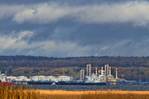
Russia's Baltic Ust-Luga port, one of its largest petroleum export hubs, has been damaged again by a Ukrainian drone attack that sparked a blaze later brought under control. The port, operated by Russian oil pipeline monopoly Transneft, handles around 700,000 barrels per day of oil exports. This disruption in the oil supply chain is particularly concerning given the recent surge in oil prices exceeding $100 a barrel due to global tensions, including the ongoing conflict in Iran.
The attack on Ust-Luga follows several Ukrainian drone strikes last week on Russia's western energy corridor, targeting facilities at the ports of Ust-Luga and Primorsk. These strikes caused significant damage, including the ignition of storage tanks, which forced a suspension of oil and oil product loadings. The recent wave of attacks has raised concerns about the vulnerability of Russia's critical infrastructure to drone-based attacks.
Firefighters from the Leningrad region and St. Petersburg, including two fire trains, have been involved in extinguishing the fire at the port. According to Regional Governor Alexander Drozdenko, additional firefighting resources were deployed to combat the blaze. The governor also reported that a residence had been damaged in a nearby settlement as a result of the attack.
Drozdenko had earlier stated that waves of Ukrainian drones had hit the area, causing significant damage and disruption to the port's operations. The scale of the damage is currently being assessed, with Reuters unable to immediately verify the extent of the harm caused by the attack.
The Ust-Luga port has been a critical component of Russia's oil export strategy, handling around 700,000 barrels per day of oil exports. In 2025, the port shipped over 32.9 million metric tons of oil products, making it one of the largest petroleum export hubs in the country.
The recent drone attacks on Ust-Luga have significant implications for Russia's oil supply and global market dynamics. The disruption to oil exports could lead to increased prices and reduced demand for Russian oil, further exacerbating the economic impact of the conflict.
The ongoing conflict between Ukraine and Russia has resulted in a series of drone strikes targeting critical infrastructure, including energy facilities and ports. These attacks demonstrate the evolving nature of modern warfare, where drones are increasingly being used as a tool of asymmetric warfare.
The international community is watching with interest as the situation at Ust-Luga continues to unfold. The impact of these drone attacks on Russia's oil supply and global market dynamics will be closely monitored in the coming days and weeks.
As the situation at Ust-Luga stabilizes, attention will turn to assessing the full extent of the damage caused by the attack and determining the necessary steps to prevent similar incidents in the future.
The recent drone attacks on Russia's energy infrastructure have significant implications for the country's oil supply and global market dynamics.