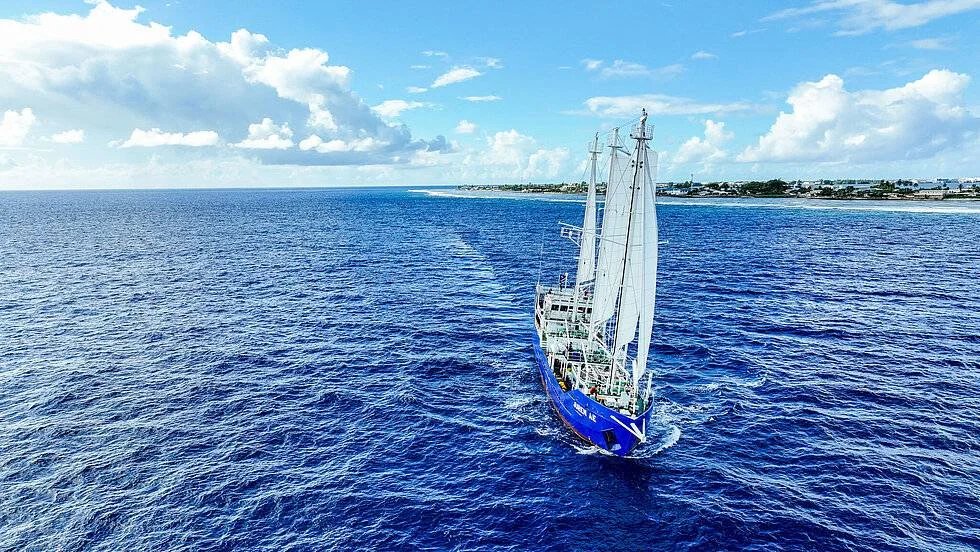
The Republic of the Marshall Islands marked a significant milestone in its transition to wind-powered transport with the delivery of the sailing cargo vessel Juren Ae in October 2024. This historic event signifies a new era in wind-propelled transport in Oceania, as the vessel's name refers to the 'steering paddle' on a traditional Marshallese canoe. The partnership behind this project, co-chaired by Fiji and the Marshall Islands, is a testament to the region's commitment to decarbonizing domestic and regional maritime transport.
The Pacific Blue Shipping Partnership includes several nations from the Pacific region, including Kiribati, Solomon Islands, Tonga, Vanuatu, Tuvalu, the Federated States of Micronesia, and Palau. These countries are working together to phase out their existing fossil fuel-powered fleets and reduce their reliance on expensive imported fuels.
The phasing out of fossil fuels will not only help reduce greenhouse gas emissions but also alleviate the financial burden of importing these fuels, which can be a significant strain on island economies.
However, the transition to wind power requires significant investment. The small cargo and passenger volumes in the region, combined with long distances between islands, make it challenging to justify the cost of new vessels solely for commercial gain.
In an effort to bridge this funding gap, public/private partnerships are being explored to develop more wind-powered vessels. This collaborative approach will enable the region to tap into innovative solutions while maintaining a culturally grounded approach to sustainable sea transport.
The connection between traditional canoe technology and modern sustainable sea transport is already being utilized in the Marshall Islands. For example, a low-cost catamaran has been built for transporting copra within atolls, demonstrating the practical application of wind power in regional transportation.
Researchers have noted that exploring historical solutions can provide valuable insights into innovative approaches to sustainability. By embracing traditional knowledge and skills, contemporary societies can develop effective strategies for reducing their environmental footprint.
The Juren Ae is a 481-gross tonne general-purpose cargo vessel designed as an initial proof of concept for the partnership. Its direct wind propulsion system accounts for 80% of its propulsive energy needs, showcasing the potential of wind power in maritime transport.
Future developments in wind-powered vessels are expected to be scalable, with designs capable of being adapted into larger versions. The success of the Juren Ae will pave the way for more ambitious projects, including the replacement of aged second-hand ro-ro vessels like the Lomaiviti Princess fleet in Fiji.
The integration of wind power into maritime transport has the potential to significantly reduce carbon emissions and promote sustainable development in the region.