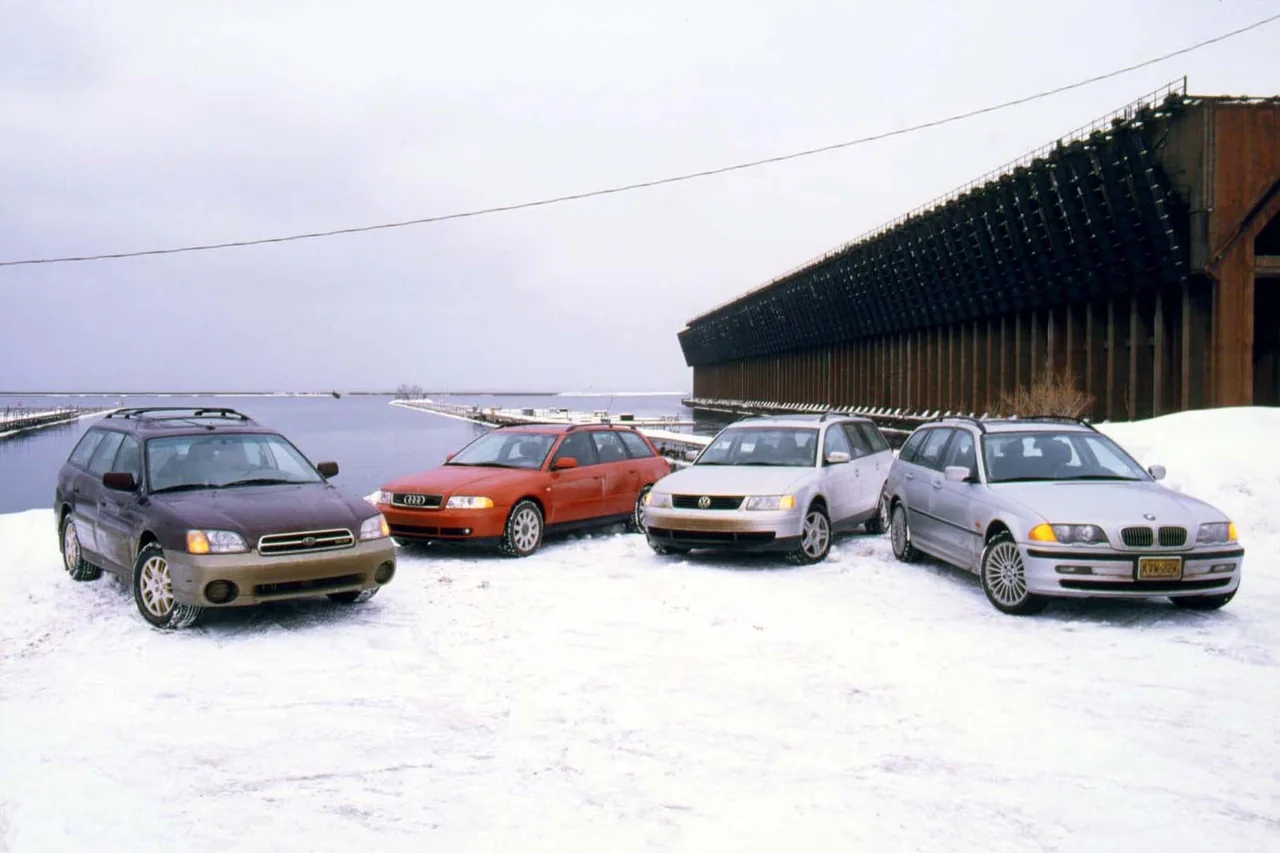
Station wagons are becoming cool again, with 10 manufacturers showcasing new models at the Detroit auto show. These sporty wagons ditch traditional terminology and instead opt for euphemisms like Mazda's Protegé 5, Lexus's IS300 SportCross, and Audi's S6 Avant. 0, and Volkswagen Passat V-6.
All-wheel drive comes standard on all Subaru and Audi wagons, while BMW's 'xi' system adds $1750 and VW expects half of all V-6 Passats to be ordered with 4Motion at the same price. The A4 Quattro and Passat 4Motion systems are identical, using a center differential that apportions torque equally between front and rear axles under normal driving conditions. When a wheel spins, a Torsen limited-slip device routes more torque to the axle with the best grip.
Audi now offers an electronic stability program on all A4s, but our test car lacked this option. BMW's system employs a planetary center differential that permanently apportions 38 percent of the torque forward and 62 percent to the wheels that traditionally motivate BMWs. 0 VDC uses a similar planetary center differential, which normally splits thrust 45/55 front to rear.

We tested these wagons in snowy conditions, armed with winter gear and a controlled environment at Delphi Automotive Systems' test facility. The lone Japanese entrant, the Subaru Outback, stood out from the start with its utility-oriented design and high-tech boxer-six engine. On paper, its credentials are impeccable, but its performance was hindered by its four-speed automatic transmission and exceptionally tall gearing.
The increasing popularity of station wagons is a welcome trend in the automotive world, offering practicality and versatility without sacrificing style. As we tested these all-wheel-drive wagons in snowy conditions, it became clear that each model had its strengths and weaknesses, reflecting their unique design philosophies and engineering approaches.