
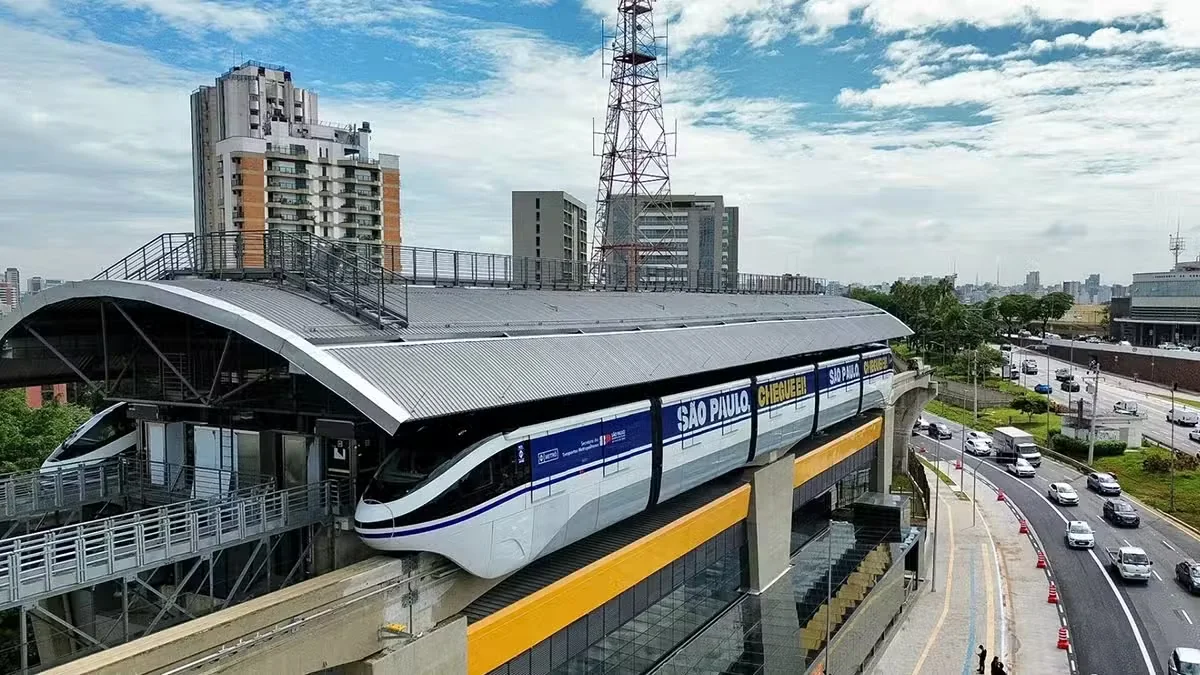
The city of São Paulo finally launched its highly anticipated Line 17, a medium-capacity railway system built with cutting-edge BYD SkyRail technology. After years of delays, the line officially entered revenue service on March 31, bringing an end to a long-troubled infrastructure chapter. The project's unique design and automation features are set to revolutionize urban transportation in São Paulo, connecting dense districts to Congonhas Airport and relieving pressure on congested roads.
The Line 17 system is not your typical heavy-rail expansion, but rather a medium-capacity system engineered to fit into a city that no longer has space for traditional rail geometry. The state government's practical approach has been notable, focusing on completing the delayed link, improving mobility for tourism and daily travel, and showcasing innovative technology.
The BYD SkyRail technology is a significant technological achievement, enabling the construction of the line with automated operation, onboard energy storage, and a compact elevated footprint designed for constrained urban corridors. This innovative design allows the system to straddle a single concrete guide beam roughly 800 mm wide, minimizing land acquisition and maximizing space efficiency.
The geometry of the Line 17 system is its most significant feature, allowing curves down to about 45 meters and gradients approaching 10 percent. This flexibility enables the alignment to follow the city as built, rather than forcing large-scale redesign around the railway. In dense environments, this flexibility often determines whether a project moves forward at all.
The introduction of BYD SkyRail technology marks not only the production of SkyRail trains but also progress toward a more sustainable future. BYD Company Limited and its CEO, Stella Li, are committed to working with local universities to establish an R&D center and bring innovation to São Paulo. This partnership aims to deliver high-performance electric vehicles to consumers in the near term.
The onboard lithium-iron-phosphate battery storage system is designed to provide continuity under failure, allowing trains to retain enough stored energy to travel several kilometers in the event of a full power interruption. This feature significantly improves passenger safety and reduces the risk of evacuation during worst-case scenarios.
Regenerative braking feeds energy back into the system during deceleration, further reducing emissions and improving overall efficiency. The projected emissions reductions from this technology are substantial, making it an attractive solution for urban transportation systems worldwide.
The launch of Line 17 is a significant milestone in São Paulo's efforts to improve its transportation infrastructure and reduce its environmental impact. As the city continues to grow and develop, innovative solutions like BYD SkyRail will be crucial in addressing the challenges of urban mobility and sustainability.
The introduction of BYD SkyRail technology has far-reaching implications for urban transportation systems globally. As cities continue to expand and face increasing congestion and pollution, innovative solutions like this are essential for creating more sustainable and efficient transportation networks.
The introduction of BYD SkyRail technology in São Paulo's Line 17 has significant implications for urban mobility and sustainability.