
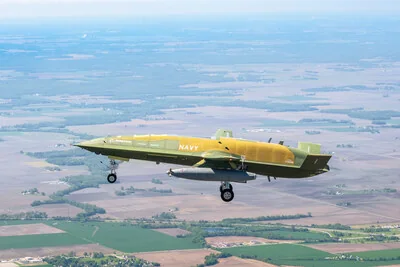
Boeing and the U.S. Navy have marked a significant milestone with the successful completion of the first test flight of the MQ-25A Stingray, an unmanned aerial vehicle designed for carrier operations. This achievement is a crucial step towards integrating unmanned systems into the Navy's air wing, heralding a new era in naval aviation. The test flight not only demonstrates the aircraft's capabilities but also sets the stage for future developments in carrier-based operations.
The MQ-25A Stingray's two-hour flight showcased its ability to autonomously taxi, take off, and land while responding to commands from the Unmanned Carrier Aviation Mission Control System MD-5 Ground Control Station. This level of autonomy is unprecedented in naval aviation and represents a significant advancement in technology. The flight took place at MidAmerica St. Louis Airport in Mascoutah, Illinois, where the program is headquartered, allowing for controlled testing and monitoring.
During the flight, the MQ-25A executed a pre-determined mission plan, validating its flight controls, navigation systems, and integration with the ground control system. The successful execution of these tasks indicates a high level of readiness for future operational scenarios. This test flight is a culmination of years of development and testing, building on insights gained from earlier prototypes.
Dan Gillian, vice president and general manager of Boeing Air Dominance, emphasized that this flight marks a significant maturation of the MQ-25A program. The aircraft is noted as the most complex autonomous system developed for the carrier environment to date. This complexity underscores the challenges and innovations involved in integrating unmanned systems into traditional military operations.
Rear Adm. Tony Rossi, overseeing the Program Executive Office for Unmanned Aviation and Strike Weapons, highlighted the flight as a landmark achievement for the collaboration between the Navy and Boeing. The MQ-25A's autonomous aerial refueling capability is expected to extend the operational range of carrier air wings significantly, allowing manned aircraft to focus on their primary combat roles.
The MQ-25A is set to revolutionize the way the Navy conducts its operations at sea. By enabling manned-unmanned teaming, the Stingray will enhance the effectiveness of existing aircraft like the F/A-18 Super Hornet, which currently performs aerial refueling. This shift in operational capability will likely lead to improved mission outcomes and a more versatile naval fleet.
Boeing plans to deliver four Engineering Development Model aircraft to the Navy as part of an $805 million contract. These aircraft will undergo further testing to validate their performance and capabilities before transitioning to Naval Air Station Patuxent River in Maryland. This transition is critical for preparing the MQ-25A for eventual integration into carrier operations.
The successful completion of this test flight is a testament to the teamwork and dedication of both Boeing and Navy personnel involved in the MQ-25 program. Troy Rutherford, vice president of the Boeing MQ-25 program, noted that the achievement underscores the importance of disciplined teamwork and rigorous testing in developing advanced military technology. As the program progresses, the implications for naval aviation are profound, potentially redefining how the Navy conducts air operations.
The successful test flight of the MQ-25A could reshape carrier operations and enhance naval capabilities significantly.