

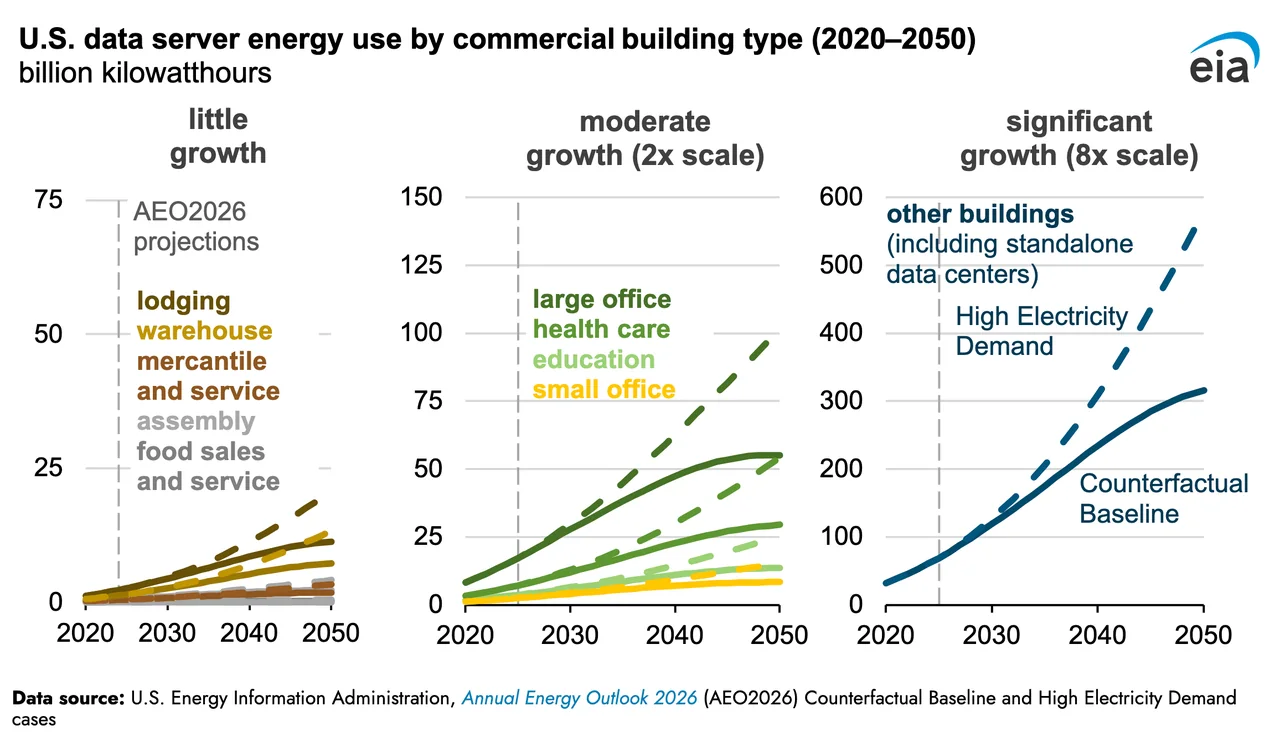
Data centers are projected to consume a significant portion of commercial building electricity by 2050, with estimates ranging from 22% to 33%. This growth is driven primarily by the expansion of standalone data centers, which will account for the majority of server consumption. The highest end of the range reflects faster growth in server power draw and installed stock in our High Electricity Demand case.
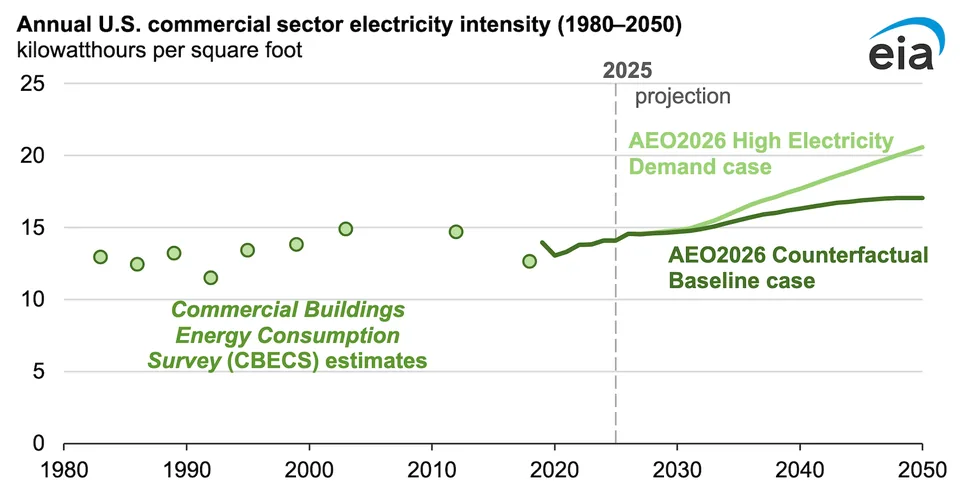
The commercial sector's electricity intensity has surpassed the 2003 historical high of 14.9 kWh per square foot for the first time in 2031-2032. This increase is largely attributed to data center servers and associated end uses, such as space cooling and ventilation, which are becoming increasingly energy-intensive. The newest buildings constructed from 1990 onward have electricity intensity twice that of the oldest buildings, constructed prior to 1959.
The growing demand for data center servers requires significant investments in cooling systems and energy-efficient technologies. Assuming space cooling requirements in data center floorspace are as much as 2.9 times as energy-intensive as non-data center floorspace, service demand for space cooling is sensitive to assumptions about population migration and the weather. This highlights the need for more efficient cooling solutions to mitigate the impact of climate change.
The updated Commercial Demand Model reports data center server electricity use separately from the broader category of commercial computing. Data center servers are assumed to have an end-use load shape that is essentially flat, meaning demand for electricity to power servers is consistent across all hours in a day.
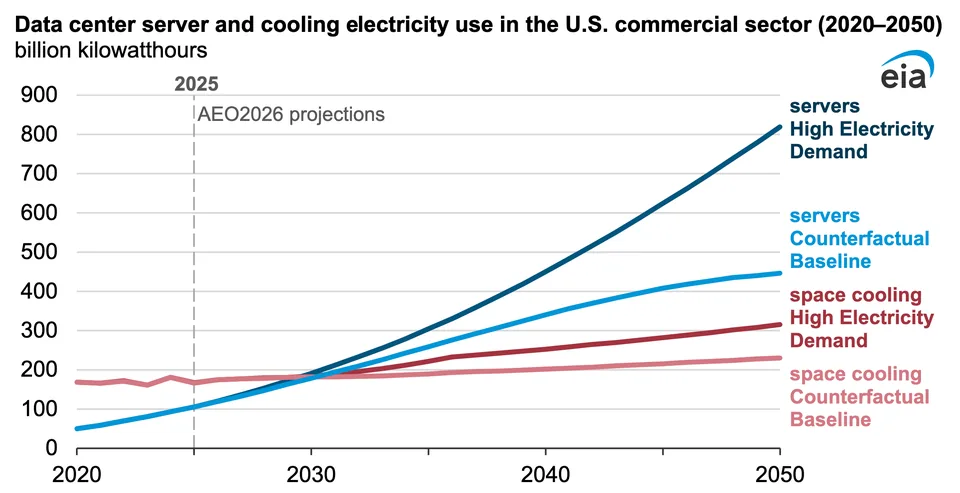
In our Counterfactual Baseline case, we assume that after 2040, servers will become increasingly efficient, resulting in a 10% reduction in average annual operational power draw every three years. However, continued growth in server installations drives overall consumption growth. This highlights the need for more sustainable data center practices and energy-efficient technologies to mitigate the impact of increasing demand.
The High Electricity Demand case assumes that AI servers will account for a larger share of the installed stock, driving faster growth in server power draw and installed stock. This scenario reflects the growing trend towards edge computing and the increasing importance of data centers in supporting cloud infrastructure.
Data center energy consumption is expected to grow significantly over the next few decades, driven primarily by the expansion of standalone data centers. As a result, it is essential for policymakers and industry stakeholders to develop strategies to mitigate the impact of this growth on commercial building energy consumption.
The increasing demand for data center servers will require significant upgrades to cooling systems and energy-efficient technologies. This highlights the need for more sustainable data center practices and energy-efficient technologies to mitigate the impact of increasing demand.
By 2050, data centers are projected to consume between 22% and 33% of commercial building electricity. This growth is driven primarily by the expansion of standalone data centers and the increasing importance of data centers in supporting cloud infrastructure.
The growing demand for data center servers highlights the need for more efficient cooling solutions and energy-efficient technologies. As the industry continues to evolve, it is essential to develop strategies that balance the needs of business operations with environmental sustainability.
The increasing demand for data center servers will require significant upgrades to cooling systems and energy-efficient technologies.

