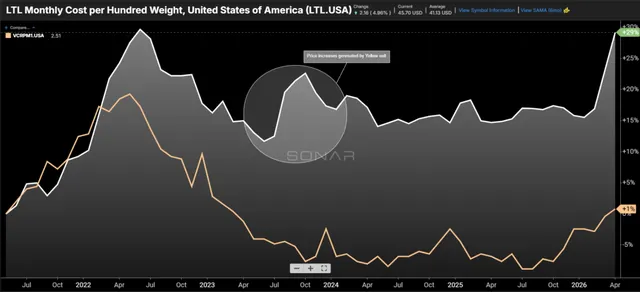

The diesel price used for most fuel surcharges has continued its upward trend, rising for the fifth straight week. The Department of Energy/Energy Information Administration announced a 2.3 cents/gallon increase in the average weekly retail diesel price on Monday, bringing it to $3.711/g. This marks a significant increase from the benchmark price of $3.459/g just five weeks ago, which had been steadily rising due to various market factors. The recent price surge has been attributed to the brutal winter in the U.S. Northeast, where heating oil is the primary fuel used for warmth. As diesel and heating oil are structurally similar, their prices often correlate with each other, leading to a higher demand for diesel fuel in this region. This increased demand has contributed to the recent price increases, which have resulted in a total increase of 25.2 cents/gallon over the past five weeks. The price surge has also been influenced by geopolitical tensions and supply disruptions, which have impacted the global energy market. As a result, industry analysts expect the recent price increases to continue due to these factors.
The correlation between diesel and heating oil prices is high, as both fuels are used for similar purposes in the U.S. Northeast region. The recent price surge in diesel fuel has been driven by the increased demand for heating oil during the harsh winter months. This demand has led to a higher price for diesel fuel, which has also been influenced by the brutal winter weather conditions in this region. The lack of significant changes in the spread between ULSD and Brent, the world's crude benchmark, suggests that the market may have reached a temporary period of stability after the initial surge in prices earlier this year.
The International Energy Agency (IEA) has published supply and demand forecasts for 2026, which show an enormous surplus of supply relative to demand. The IEA's February report widened the gap between supply and demand, projecting that global demand growth for 2026 would be 850,000 barrels/day, down from 930,000 barrels/day in January. Despite this bearish forecast, investors who view oil as an asset class are not buying the bearish scenario, citing potential risks to production and tanker traffic.
The recent price surge in diesel fuel has been driven by a combination of factors, including geopolitical tensions and supply disruptions. The brutal winter weather conditions in the U.S. Northeast have led to increased demand for heating oil, which has in turn driven up the price of diesel fuel. The lack of significant changes in the spread between ULSD and Brent suggests that the market may have reached a temporary period of stability after the initial surge in prices earlier this year.
The bullish views on oil prices are evident in the recent data from commodity exchanges, which show net buying by investors in oil contracts. This increased demand for oil has led to higher prices, with ULSD rising 8.43 cents/gallon to $2.4749/g at midday on Wednesday. If this price holds, it would be the highest settlement of the month.
The recent price surge in diesel fuel has significant implications for the industry, particularly for those operating in the transportation sector. The increased cost of diesel fuel will likely lead to higher operating costs for trucking companies and other businesses that rely on diesel fuel. This could have a ripple effect throughout the supply chain, leading to higher prices for consumers.
The recent price increases in diesel fuel are also influenced by the geopolitical tensions in the region. The threats of U.S. military action against Iran and stricter sanctions enforcement have led to increased uncertainty in the global energy market. This uncertainty has resulted in higher prices for oil, which is reflected in the recent price surge in diesel fuel.
The recent price surge in diesel fuel highlights the importance of understanding the complex factors that influence the energy market. The correlation between diesel and heating oil prices, as well as the impact of geopolitical tensions and supply disruptions, are just a few examples of the many factors at play. As the industry continues to navigate these complexities, it is essential to stay informed and adapt to changing market conditions.
As the market continues to evolve, it is likely that we will see further price increases in diesel fuel. The bullish views on oil prices, combined with the ongoing supply disruptions and geopolitical tensions, suggest that the recent price surge is unlikely to be a temporary phenomenon. Industry analysts expect the recent price increases to continue due to these factors, which will have significant implications for the industry and consumers alike.
Industry analysts expect the recent price increases to continue due to geopolitical tensions and supply disruptions.