The steel industry has been mistakenly framed as a future hydrogen market, leading to discussions about electrolyzers, pipelines, and storage caverns. This framing is convenient for hydrogen advocates but does not accurately represent how the steel system works.
Steel is not a fuel that disappears when used; instead, it accumulates in buildings, bridges, ports, rail, vehicles, ships, appliances, industrial equipment, pipes, and transmission towers, then returns as scrap when those assets retire. This stock-and-flow reality is the starting point for a serious steel transition.
The useful questions are not how much hydrogen the sector might absorb if it were cheap and abundant but rather how much steel the world actually needs, how much can come from scrap, how much clean primary iron remains, and which production routes can deliver it under real constraints.
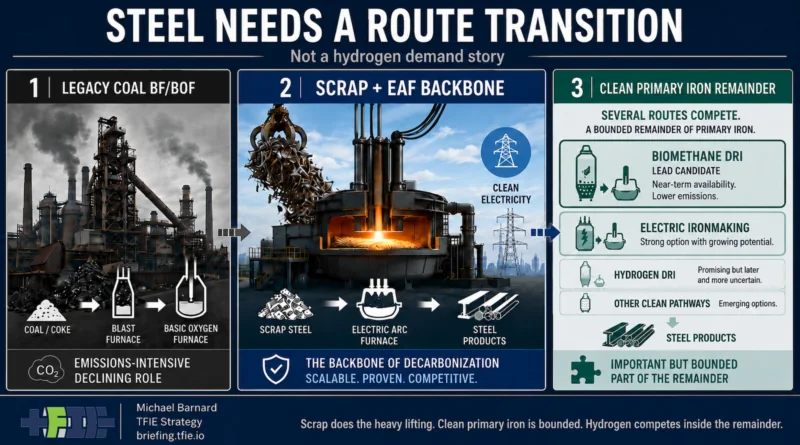
A route shift, not a hydrogen-demand forecast, is necessary for a serious steel transition. Scrap-fed electric arc furnaces do most of the long-term work, clean primary iron remains a large but bounded category, and the legacy coal-based blast furnace and basic oxygen furnace route has to exit if the sector is to align with serious climate targets.
The scale of the problem is significant; worldsteel's latest figures put 2024 crude steel production at about 1.88 billion metric tons, with average emissions of 2.18 tons of CO₂e per ton of steel. Steel is one of the largest industrial emissions problems on the planet.
If steel is framed as a hydrogen market, the industry becomes a convenient sink for hydrogen infrastructure plans. However, this framing overlooks the importance of scrap and electric arc furnaces in delivering lower-carbon steel.
The direction forward relies on mature industrial equipment like electric arc furnaces, which already make a substantial share of global steel where scrap streams, electricity systems, and product requirements line up.
In mature economies, recycled steel in electric furnaces is the long-term backbone of lower-carbon steel, not a universal pivot to hydrogen. Alloy contamination, furnace utilization, and clean electricity matter but do not change the basic direction.
Developing economies can benefit from this approach by leveraging scrap-fed electric arc furnaces to reduce their carbon footprint and transition towards more sustainable production methods.
The steel industry's path forward relies on a shift from hydrogen to scrap-fed electric arc furnaces, which are mature industrial equipment that already make a substantial share of global steel.