
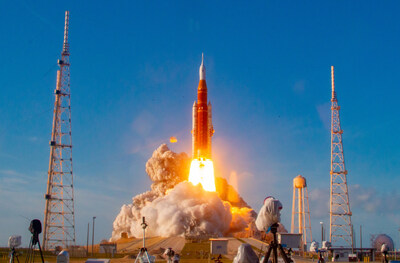
On April 1, 2026, NASA's Space Launch System (SLS) rocket, featuring a core stage built by Boeing, successfully lifted off from Kennedy Space Center at 6:35 p.m. ET. This monumental launch marked a significant milestone in NASA's Artemis program, aimed at returning humans to the Moon and eventually exploring Mars. The SLS rocket is designed to carry astronauts beyond low Earth orbit, showcasing advancements in aerospace technology and engineering.
Eight and a half minutes into the flight, the Boeing-built core stage completed its mission by successfully separating from the upper stage of the rocket. This critical separation allowed NASA's Orion spacecraft, named Integrity, to embark on its 10-day lunar journey. The mission is historic, as it carries a crew of four astronauts, including three from NASA and one from the Canadian Space Agency, marking a significant step in international collaboration in space exploration.
Boeing's commitment to NASA's mission was highlighted by Steve Parker, the president and CEO of Boeing Defense, Space & Security. He emphasized the importance of restoring capabilities that are vital to the nation's interests and future. The successful launch not only reflects Boeing's engineering prowess but also reinforces the company's role in advancing human spaceflight and exploration.
The core stage of the SLS rocket is an engineering marvel, standing at 212 feet, or nearly 65 meters tall. It houses a 196,000-gallon liquid oxygen tank and a 537,000-gallon liquid hydrogen tank, which are essential for fueling the rocket's powerful engines. The design includes an intertank section that connects the two fuel reservoirs, a forward skirt for upper stage attachment, and an engine section equipped with four RS-25 engines, collectively generating an impressive 2.2 million pounds of thrust.
In preparation for this mission, the core stage underwent rigorous testing and operations, including pre-launch fueling, hydraulic system activation, engine ignition, and thrust vector control during flight. Each of these operations was critical to ensuring the safety and success of the crewed mission. The successful execution of these tasks demonstrates the reliability and capability of the SLS rocket, which is designed to withstand the immense forces of launch.
John Shannon, vice president of Boeing's Exploration Systems business, expressed pride in witnessing the astronauts embark on their historic mission. He reiterated the company's focus on vehicle quality and crew safety, highlighting the extensive efforts of the dedicated team and partners involved in the project. The successful launch not only represents a technological achievement but also a testament to the collaborative spirit of the aerospace industry.
Boeing's Michoud Assembly Facility in New Orleans plays a crucial role in the production of the SLS core stage, utilizing components sourced from suppliers across more than 38 states. This widespread collaboration emphasizes the economic impact of the aerospace sector, fostering job creation and innovation throughout the country. As the next core stages for Artemis III to V missions are already in production, Boeing continues to contribute to the future of space exploration.
As a leading global aerospace company and a top U.S. exporter, Boeing is dedicated to developing, manufacturing, and servicing a wide range of aerospace products. The company's commitment to safety, quality, and integrity underpins its operations and partnerships, driving advancements in commercial aviation, defense, and space systems. With ongoing projects and missions, Boeing is poised to play a pivotal role in shaping the future of human space exploration.
The successful launch of the Artemis mission underscores the importance of collaboration between government and private aerospace companies, paving the way for future deep space exploration.