


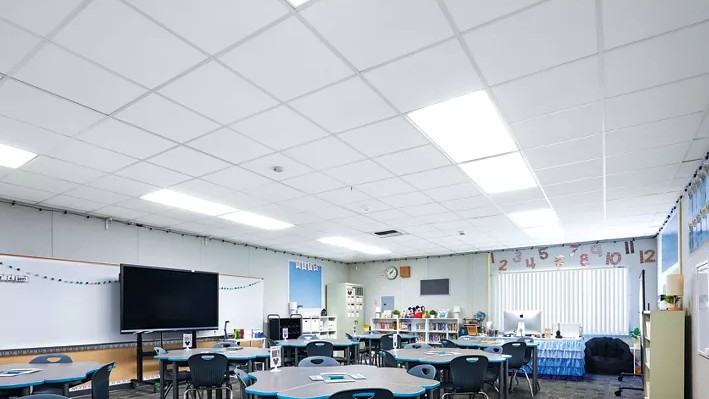
At the New York Build Expo, a visit to the Armstrong booth revealed an innovative solution for thermal energy storage using phase change materials. Initially, the exhibit appeared unassuming, with traditional acoustic ceiling tiles that did not draw attention to themselves. However, upon inquiry about clean technology innovations, the staff pointed to their new Templok ceiling tiles with integrated phase change material. These tiles offer a practical and efficient way to harness thermal energy without requiring complex systems or conspicuous designs.
The Phase Change Material (PCM) in Templok ceiling tiles functions by absorbing heat as it becomes liquid and releasing heat as it solidifies, utilizing the process of dissolution/crystallization rather than melting/freezing. This material is comprised of a salt-based solution within a metallized polymer pouch, providing a compact and lightweight thermal energy storage solution.
Despite its unassuming appearance, with a mere few millimeters thickness on the back of a standard ceiling tile, Templok's PCM material boasts remarkable thermal mass properties. According to Armstrong, one lightweight ceiling panel has the same effective thermal mass as 11 bricks, making it an attractive option for commercial buildings seeking to reduce energy consumption.
When interacting with the material, users can feel its ability to absorb and release heat, but it does not feel uncomfortably cold. The PCM's temperature range is also beneficial, allowing it to be formulated to release or absorb heat at room temperature. This enables passive temperature modulation over a large surface area while preventing condensation formation.
The design of Templok takes into account the thermal dynamics of suspended ceiling tiles, which can act as insulated partitions between conditioned air and unconditioned air spaces. As a result, temperature fluctuations above the tile tend to be greater than those experienced within the room, especially if the building's roof is located above the ceiling tile.
To accommodate the phase change material's limitations, such as its inability to be cut, Armstrong uses cosmetically identical ceiling tiles without PCM for edges and areas with holes for sprinklers, lights, speakers, etc. This ensures that roughly ⅔ of the ceiling tiles contain PCM, optimizing system performance.
The Templok ceiling tile system is projected to save energy costs by up to 15%. While this may seem like a modest figure, it is essential to consider the significant energy bills associated with commercial HVAC systems. The actual savings will depend on various factors, including temperature fluctuations and system efficiency.
In optimal conditions, where the tile is kept at a steady temperature, the phase change material's ability to store and release heat is minimized, resulting in reduced benefits. Conversely, when the temperature changes above or below the tile, the PCM's performance becomes more pronounced, leading to greater energy savings.
The integration of phase change materials like those found in Templok ceiling tiles represents a significant step forward in thermal energy storage technology. As the industry continues to evolve, it will be essential to evaluate and refine these solutions to maximize their potential for reducing energy consumption and costs.
The integration of phase change materials in building design can significantly reduce energy costs, but its effectiveness depends on various factors such as temperature fluctuations and system efficiency.